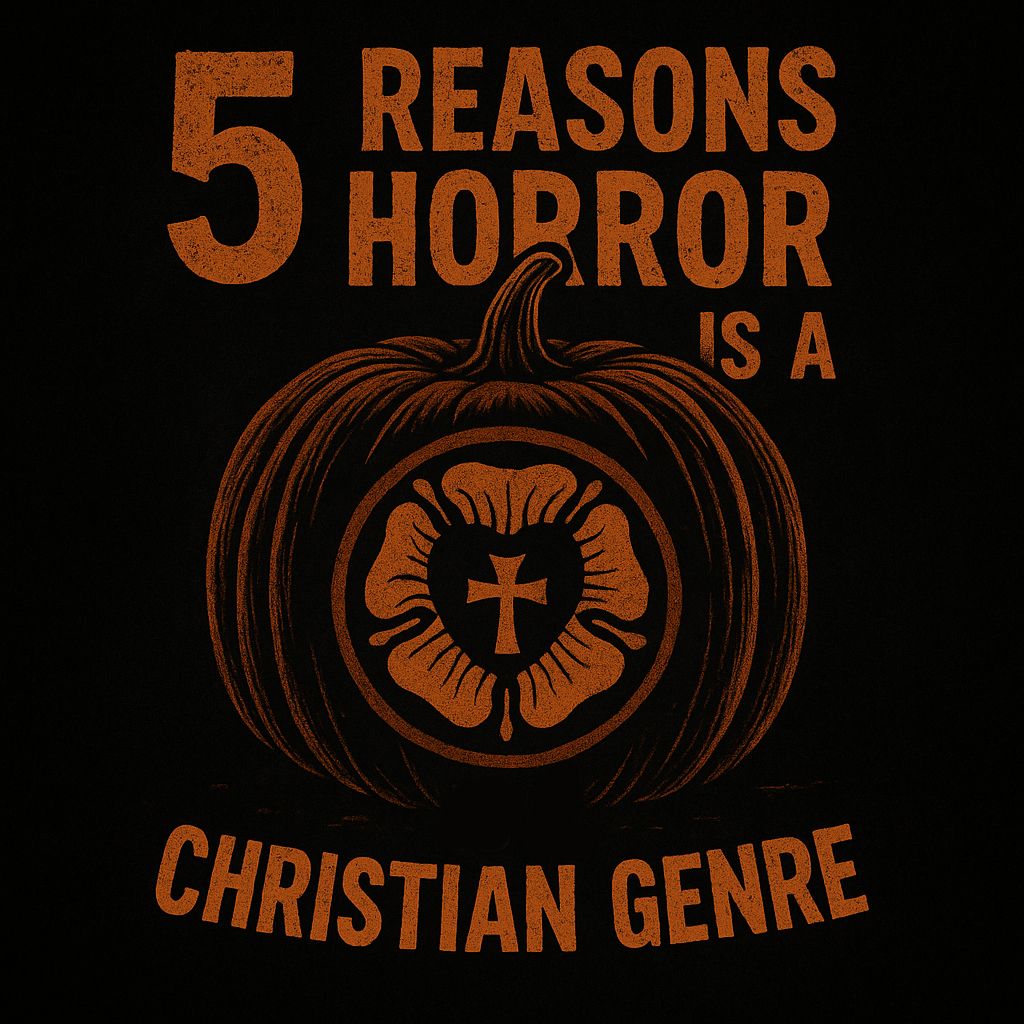
5 Reasons Horror is a Christian Genre
The cross, the crypt, and the monster’s shadow all tell the same truth: only Christ conquers the darkness.

Spooky season is finally approaching. Yes, I know—it’s still nearly two months until Halloween. But admit it: you’ve already heard someone humming the Monster Mash, you’ve already seen pumpkin spice latte posts clogging your feed, and somewhere in the neighborhood, a Dollar General has gone from “Back to School” to “Cemetery Chic” overnight.
Quick Sidenote: My Halloween obsession runs so deep that I designed the 'Halloween is a Christian Holiday' gear you see below. My coffee mug bears this declaration every October morning, and yes, I've worn the shirt to church cookouts. If you want to join my theological Halloween revolution—and toss a few coins into my creative coffers—check out my merch store here.

Christians often ask me, “Pastor, should we even watch or read horror?” The assumption is that horror belongs to the world, to the occult, to unbelief. But here’s the shocking reality: horror, rightly understood, is one of the most Christian genres in existence. It reveals the truth about sin, death, the devil, and the One who conquers them.
So let’s walk into the shadows together. Here are five reasons why horror is a Christian genre.
1. Horror Tells the Truth About Sin and Death
Horror strips away the lies we tell ourselves about how “nice” the world is. It shows the wages of sin in vivid, terrifying imagery. St. Paul says:
“For the wages of sin is death; but the free gift of God is eternal life in Christ Jesus our Lord” (Romans 6:23, ASV).
The genre of horror thrives on this very verse. Monsters, ghosts, and zombies are grotesque parables of sin’s decay. Augustine described sin as a turning away from the Creator to the creature, and thus deformity:
“For when the will abandons what is above itself, and turns to what is lower, it becomes evil—not because that is evil to which it turns, but because the turning itself is wicked” (City of God, Book XII, 6).
Likewise, the Apology of the Augsburg Confession reminds us that original sin is not only a corruption of the physical body, but also of the soul, and of the inmost powers of man’s nature. (Apology II, 23).
Horror doesn't flatter us with comforting platitudes or sugar-coated delusions about human nature. Instead, it serves as an unflinching mirror, painting sin for exactly what it truly is—putrefying flesh that speaks to our mortality, fractured minds that reveal the corruption of our fallen reasoning, and a world caught in an inexorable spiral into complete and utter chaos. The genre refuses to let us hide behind our carefully constructed facades of respectability and progress. It drags us, kicking and screaming if necessary, into the harsh light of reality where we must confront the uncomfortable truth that all is not well with the human condition.
2. Horror Acknowledges the Reality of the Devil
The modern world, with its smug secular sophistication, desperately wants to reduce Satan to nothing more than a laughable caricature—a Halloween costume complete with ridiculous red tights, plastic horns, and a theatrical pitchfork borrowed from some community theater's prop closet. This cartoonish dismissal serves a purpose: it allows us to sleep soundly at night, convinced that evil is merely a quaint superstition left over from our supposedly ignorant ancestors.
Horror fiction, by stark and unsettling contrast, refuses to play along with this comfortable delusion. The genre often takes the reality of genuine evil with deadly seriousness, presenting malevolent forces that are cunning, patient, and terrifyingly effective in their destruction. Whether through possession narratives, demonic antagonists, or supernatural terror that defies rational explanation, horror acknowledges what our sanitized culture desperately wants to deny.
And the Christian, armed with Scripture and centuries of theological wisdom, knows with absolute certainty that the devil is not some bumbling cartoon villain designed to sell Halloween decorations. He is, as Christ himself declared, "a murderer from the beginning" (John 8:44)—a real and present danger whose very existence our culture has systematically trivialized at its own peril.
Luther, in the Large Catechism, warns us:
“The devil is called the master of a thousand arts. But what shall we call God’s Word, which drives away and brings to naught this master of a thousand arts with all his arts and power? It must indeed be the master of more than a hundred thousand arts.” (LC, Preface 12).
Demons in horror stories are frightening not because they’re fake, but because they echo the truth of Ephesians 6:12:
“For our wrestling is not against flesh and blood, but against the principalities, against the powers, against the world-rulers of this darkness, against the spiritual hosts of wickedness in the heavenly places” (ASV).
Horror reminds us the battle is real—and the devil is no joke.
3. Horror Confronts the Fear of Death
The writer of Hebrews states:
“…that through death he might bring to nought him that had the power of death, that is, the devil; and might deliver all them who through fear of death were all their lifetime subject to bondage” (Hebrews 2:14–15, ASV).
Horror exposes our deepest, most primal fear with unrelenting precision: that we are nothing more than dust, and to dust we shall inevitably return. Every skeleton that rattles across our screens, every ghost that haunts our nightmares, every vampire that stalks through gothic corridors—they all serve as grotesque mirrors, mocking our human pride and pretensions of permanence. We spend our lives accumulating possessions, building legacies, pretending we're immortal, but horror strips away these comfortable delusions with surgical brutality.
But here's the key insight that makes horror truly valuable from a Christian perspective: horror is never content to let us remain comfortable in our mortality. It doesn't simply present death as a natural conclusion and walk away whistling. No, it makes us squirm in our theater seats, forces our hearts to race, compels us to grip the armrests until our knuckles turn white. It deliberately agitates that deep, existential anxiety that we spend most of our waking hours trying to suppress.
Horror forces us to confront the ultimate question that our culture desperately wants to avoid: what comes after? What happens when the credits roll on this life? When the final curtain falls, when the last breath is drawn, when the heart stops beating—then what? The genre refuses to let us settle into the comfortable atheistic assumption that death is simply the end, a peaceful fade to black. Instead, it insists there's more to the story, whether we like it or not.
The Formula of Concord says it plainly:
“Thus, we retain the substance [sound doctrine] and [true] consolation that neither hell nor the devil can take captive or injure us and all who believe in Christ.” (FC SD IX, 16).
Horror brings us face to face with mortality so that the Gospel may comfort us with immortality in Christ.
4. Horror Shows the Need for a Savior
If horror stopped at monsters and death, it would only be despair wrapped in celluloid—a nihilistic exercise designed to make us feel hopeless about the human condition. But here's where things get interesting: the Christian knows that every monster shambling across the silver screen, every supernatural force that threatens to tear apart our carefully constructed reality, points to our desperate need for a Hero—Christ Himself.
Tertullian, that brilliant early church father with his razor-sharp wit, once quipped that the devil is nothing more than "God's ape"—a pathetic mimic who copies divine power but can never actually save anyone (De Baptismo 5). It's a devastatingly accurate observation that cuts right to the heart of what horror reveals about our predicament. No matter how clever we think we are, no matter how advanced our technology becomes, no matter how brave our protagonists appear on screen, human ingenuity, science, and sheer force of will always—and I mean always—fall catastrophically short when faced with true evil.
Think about it: the slasher villain always comes back for another sequel, defying death itself. The ancient curse endures despite every attempt to break it through scholarship or modern intervention. The darkness spreads relentlessly, consuming everything in its path, regardless of how many torches we light or how loudly we whistle past the graveyard. Horror systematically demolishes our illusions of self-sufficiency, leaving us face-to-face with the uncomfortable truth that we are utterly powerless against the forces that truly threaten us.
Only the Light overcomes. John 1:5 declares:
“And the light shineth in the darkness; and the darkness apprehended it not” (ASV).
The Smalcald Articles emphasize that without Christ, all is lost:
“The first and chief article is this, that Jesus Christ, our God and Lord, died for our sins and was raised again for our justification” (SA II, I).
Horror is therefore profoundly evangelistic in its very DNA—it serves as an unwitting but powerful apologetic that systematically proves, through narrative after narrative, that only Christ truly conquers evil. Every zombie apocalypse that overwhelms human military might, every demonic possession that laughs at psychiatric intervention, every ancient evil that shrugs off modern skepticism is essentially preaching the same sermon: your secular solutions are woefully inadequate when confronted with genuine spiritual darkness.
The horror genre becomes an unlikely evangelist, standing on street corners with bloody hands raised, shouting to anyone who will listen: "Your science cannot save you! Your weapons will fail you! Your cleverness will betray you!" It's the genre that strips away our pretenses and forces us to confront the uncomfortable reality that we are not the masters of our own destiny that we pretend to be.
5. Horror Echoes the Final Judgment
Finally, horror gives us a foretaste of Judgment Day. The Book of Revelation is filled with imagery that would fit right into any gothic tale—beasts rising from the sea, bowls of wrath, blood up to the horses’ bridles.
But Revelation isn’t horror for its own sake. It is horror that ends in triumph. As St. John writes:
“And I saw a new heaven and a new earth… and he shall wipe away every tear from their eyes; and death shall be no more; neither shall there be mourning, nor crying, nor pain, any more” (Revelation 21:1, 4, ASV).
Horror forces us to feel the terror of the Last Day, but also points us to Christ’s victory. Luther captures this in his hymn A Mighty Fortress:
“Though devils all the world should fill, all eager to devour us, we tremble not, we fear no ill, they shall not overpower us.”
The darkness may close in around us like a suffocating shroud, pressing against our windows and seeping under our doors, whispering lies about our fate and filling our minds with dread. But here's the thing that separates the Christian from every other horror protagonist stumbling through the haunted house of existence: we've already read the final chapter. We know how this story ends.
We don't have to wonder if the monster will be defeated or if the nightmare will ever cease. We don't have to hope that somehow, against all odds, the hero will find a way to save the day. The victory has already been won on a hill outside Jerusalem, where the greatest horror of all—the wrath of God against sin—was absorbed by One who could bear it. The tomb is empty. Death itself has been swallowed up in victory.
So when the shadows lengthen and the fears multiply, when the world seems overrun by darkness and evil appears to have the upper hand, the Christian can face it all with a confidence that no horror movie hero ever possessed. We know the ending, and it's glorious.
Conclusion
So, as spooky season draws near, don’t despise the horror genre. Learn from it. Let it remind you of sin’s corruption, the devil’s malice, the reality of death, the need for Christ, and the certainty of Judgment. Horror, at its best, is not a denial of Christian faith—it is an echo of Christian truth.
Or to put it bluntly: horror is Christian because it tells the truth about the darkness—and the Light that has already overcome it.
Want to dig deeper into how faith and storytelling collide? Grab my free eBook "Faith, Fiction, and the Fight" when you sign up for email updates right here on Substack.