In a Hole in the Ground: Human Authorship, Artificial Intelligence, and the Right to Sub-Create


Before writing about Middle-earth, J.R.R. Tolkien worked as an Oxford professor to support his family. Like many academics with children and limited means, he took on extra work each year by grading School Certificate exams.
While grading exams, Tolkien found a page a student had left behind. On it, he wrote without much thought: "In a hole in the ground there lived a hobbit." He later admitted he did not know what a hobbit was at the time. That single sentence came before any planning, and from it grew the world of Middle-earth, including Bilbo Baggins, the Shire, Smaug, and everything else.
This raises a question: what made Tolkien the owner of the hobbit idea?
The simple answer is that Tolkien came up with the idea of the hobbit. That seems reasonable, but the law sees it differently. American copyright law does not let people own ideas, systems, concepts, facts, or methods. It only protects what is written down or recorded. No one can claim ownership of the idea of someone living underground, just as no one can own the idea of a detective solving a crime or lovers separated by their families. The law says ideas are free for anyone to use and build upon.
Even though there is a difference between an idea and how it is expressed, the original idea of the hobbit still matters. Tolkien’s simple sentence became his own work because he developed it. He thought about what a hobbit was, where it lived, what it feared, what it loved, and why it might leave home. He chose words, invented names, decided what would happen, solved problems, drew maps, planned events, and made many decisions about Middle-earth. The basic idea of the hobbit was not protected by copyright, but the story that grew from it showed Tolkien’s creativity and hard work.
This difference between an idea and how it is expressed is a good starting point for thinking about today’s debates over artificial intelligence that can generate content.
Authorship Has Never Required Making Every Mark by Hand
Copyright law has faced this confusion before. When photography appeared, critics argued a photograph was merely a mechanical reproduction created by a camera and light. In 1884, the Supreme Court rejected that simplistic view in Burrow-Giles Lithographic Co. v. Sarony. The photographer had arranged Oscar Wilde’s pose, costume, background, lighting, shadows, and expression. The camera performed the chemical and mechanical process, but the resulting photograph embodied the photographer’s “original intellectual conceptions.” The Court treated him as the author because he had given visible form to his conception.
The analogy exposes a crucial principle: an author need not physically manufacture every element of a work. A novelist does not manufacture ink. A filmmaker does not emit the light captured by the sensor. A producer may not play every instrument. A sculptor may direct assistants. A photographer may press one button after hours constructing the image.
The central issue is not whether a machine contributed to the process, as machines have assisted creative endeavors for generations. Rather, the key consideration is whether the human exercised sufficient creative control over the resulting expression.
The Copyright Office’s current position is narrower. Its 2025 report states that AI-assisted works may be protected where human-authored expression remains perceptible, or where a human creatively selects, arranges, or modifies generated material. At the same time, it says that merely supplying prompts ordinarily does not determine enough expressive elements to establish authorship.
This rule is reasonable when applied to vague prompts followed by uncritical acceptance of the initial output. For example, typing “make a cool picture of a dragon” and publishing the result differs significantly from designing the creature, specifying its anatomy, establishing the scene, controlling symbolism, revising the composition, combining multiple generations, repainting details, and rejecting numerous unsatisfactory attempts. Not every prompt constitutes authorship.
But “prompting” is too broad a category to decide the matter by itself. A prompt may be a careless sentence or it may function as a screenplay, production brief, compositional blueprint, and sequence of revisions. The pending dispute concerning Théâtre D’opéra Spatial illustrates the difficulty: its creator reported hundreds of prompt iterations and additional editing, while the Copyright Office concluded the generated portions still had to be disclaimed.
Legal analysis should focus on the extent of actual creative control, rather than treating the term “prompt” as a definitive endpoint to the inquiry.
A Better Test: Conception, Control, and Responsibility
A defensible standard for AI-assisted authorship should ask at least five questions.
First, did the human originate a sufficiently concrete conception? “Write me a fantasy novel” is almost nothing. “Write a scene in which a homesick priest discovers that the abandoned church he entered exists in three decades at once” contains characters, conflict, setting, and dramatic purpose. The idea alone is not copyrightable, but its specificity helps prove that the output did not arise as an accidental lottery ticket.
Second, did the human determine expressive elements rather than merely request a result? This includes decisions about structure, pacing, imagery, perspective, rhythm, symbolism, composition, instrumentation, and tone.
Third, did the human exercise iterative control? Rejection is itself a judgment. Revision is authorship when it progressively bends the material toward a conceived end. The author who generates twenty versions, combines selected passages, rewrites lines, changes the ending, and removes unwanted elements is doing more than receiving a machine’s gift.
Fourth, did the human select, arrange, and modify the material into the final work? Copyright has long recognized original selection and arrangement even when individual ingredients are not themselves protectable.
Fifth, is the human willing to accept responsibility? The claimant should identify human contributions honestly, preserve evidence of the creative process, avoid falsely claiming copied material, and answer for infringement or deception. Authorship without accountability is merely possession.
Applying this standard, certain AI-generated outputs would remain ineligible for copyright protection. Others would be protected solely for human-written text, human edits, or the arrangement of generated components. Some works could qualify as substantially human-authored if the human demonstrably controlled the expressive form. Ultimately, outcomes would depend on evidence rather than rhetorical assertions.

This approach also avoids the historical “sweat of the brow” fallacy. Copyright does not reward individuals solely for the amount of time invested or the number of prompts entered. The Supreme Court has established that effort alone does not constitute originality. The quantity of prompts is relevant only to the extent that it demonstrates creative judgment and effective control.
The Philosophy of the Tool
Philosophically, the argument turns on the difference between an agent and an instrument.
A chisel may cause a mark in marble, but it is not the sculptor. Similarly, a word processor produces letters on a screen, but it is not the novelist. An AI system may function as a more complex instrument, capable of surprising its user and presenting unforeseen possibilities. However, such surprise does not transform a tool into a person. Artists have long encountered unexpected outcomes in their materials: paint may run, film grain may distort, musicians may improvise, actors may alter scenes, and language may yield meanings recognized only after composition.
The human author is not always the sole causal agent. However, the author serves as the responsible center of intention and judgment, capable of declaring, “This is the work,” and articulating the rationale for its particular form.
This also reveals why originating conception matters without becoming a monopoly over ideas. The idea establishes the work’s end. It provides the “why” toward which the tools and materials are ordered. But ownership properly attaches to the particular form achieved through human choices. Thus, Tolkien could not own every underground creature in fantasy. He could own his words, characters, maps, narrative arrangements, and the distinctive world that embodied his intellectual labor.
The same principle should apply to AI-generated works. A human does not own the general concepts of “a dragon,” “a sad song,” or “a neon church.” Rather, ownership may attach to the specific human-directed expression realized through these concepts, provided the work demonstrates sufficient creative determination by the human author.
The Theology of Sub-Creation
Christian theology supplies an even deeper reason to locate authorship in the human person.
God alone creates from nothing. “In the beginning God created the heavens and the earth” (Genesis 1:1). Human beings do not speak worlds into existence by divine omnipotence. We receive matter, language, memory, culture, bodies, teachers, tools, and time. Even our reason and senses are gifts. Luther’s explanation of the First Article confesses that God gives body and soul, reason and senses, and all that is needed for this life, entirely from fatherly goodness and mercy.
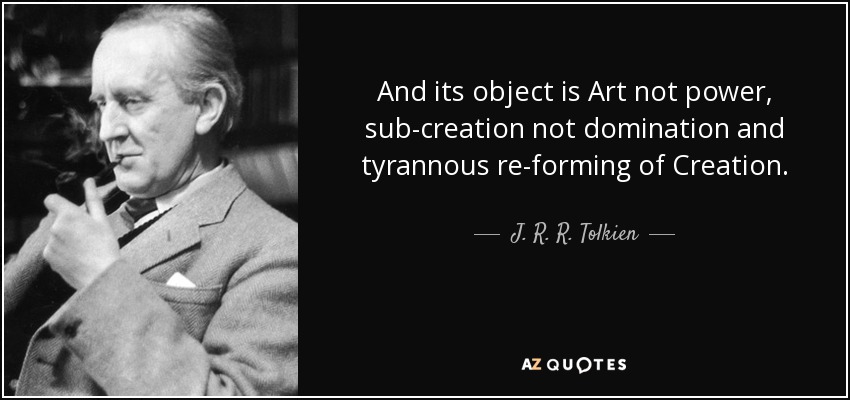
Human creativity is therefore neither divine creation nor meaningless rearrangement. It is creaturely making: receiving what God has made and forming it in service to a purpose. Tolkien called this “sub-creation,” the making of a secondary world through words while remaining a creature within God’s primary world.
Scripture presents craftsmanship in precisely this creaturely way. Bezalel did not create gold, stone, color, or human skill from nothing. God filled him with wisdom, understanding, knowledge, and craftsmanship so that he could design and make the furnishings of the tabernacle (Exodus 31:1–5). The materials were given. The skill was given. The vocation was given. Yet Bezalel truly made the work.
The existence of tools and means does not negate the role of the worker. For example, daily bread is provided through farmers, bakers, drivers, markets, ovens, and tools. Music is realized through breath, instruments, microphones, software, and speakers. Books are produced through memory, language, keyboards, editors, and presses. From a Christian perspective, reliance on tools does not imply independence from God, nor does it diminish one’s vocational responsibility.
AI must therefore be neither worshiped nor demonized. It is not a little god that creates beside the Creator. It is not a soul trapped in a machine. It is a human artifact operating within creation. It may be used wisely or foolishly, honestly or deceptively, beautifully or wickedly.
The theological limits are serious. “You shall not steal” forbids plagiarism and the unlawful taking of a neighbor’s work. “You shall not bear false witness” forbids lying about one’s process or claiming another person’s labor as one’s own. Love of neighbor requires concern for artists whose work is exploited. Stewardship requires judgment rather than laziness. An AI user who asks a machine to imitate a living artist, accepts copied passages, conceals material facts, and claims solitary genius is not defending sub-creation. He is using theological language to baptize theft and vanity.
However, misuse does not negate legitimate applications. A camera may invade privacy or capture a family portrait. A sampler may unlawfully appropriate a recording or contribute to a licensed composition. A printing press may disseminate heresy or a catechism. Moral evaluation should focus on the use, the source material, the creator’s honesty, and the outcomes produced, rather than on irrational apprehension regarding the instrument itself.
The Rightful Human Creator
A more rigorous conclusion is required than the assertion that “whoever typed the prompt owns everything.” Such a claim is philosophically superficial, legally incorrect, and susceptible to clear abuse.
A more appropriate conclusion is that when a human originates a creative conception, determines substantial expressive elements, directs and revises the process, selects and arranges the final material, and accepts responsibility for the work, the use of generative AI should not deprive that individual of authorship. The machine remains an instrument. Copyright protection should extend to human-authored expression, while excluding unprotectable ideas, copied elements, and material not meaningfully controlled by the human.
Tolkien’s blank page did not contain Middle-earth. It contained a door.
He walked through it by asking questions, making judgments, and laboring until the strange word “hobbit” acquired history, geography, appetite, courage, and a round green door. Had he used a typewriter, a secretary, a camera, a word processor, or some future machine to help give visible form to that world, the machine would not thereby become the mind from which Middle-earth proceeded.
The sub-creator is not the one who touches every atom. He is the human person who receives the materials of creation, orders them toward an intelligible end, and gives accountable form to an idea.
The machine can generate.
The human must provide the meaning.