The Artist Is Not Justified by Works
Effort, Property, Communism, and the Theology Behind the AI Panic

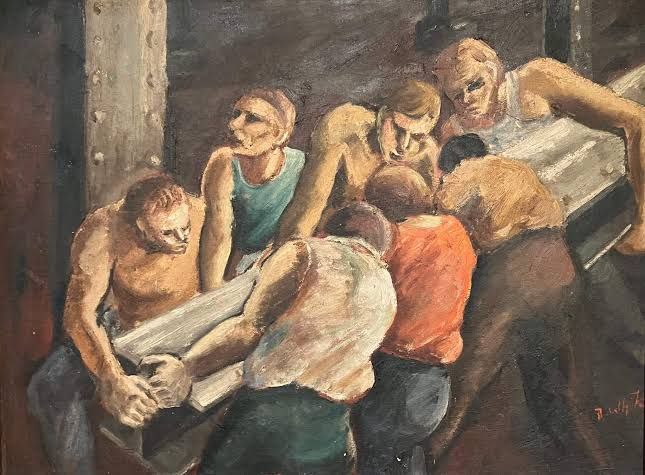
An argument appears almost everywhere in the debate over artificial intelligence and creative work. It usually sounds like this: A human artist spent years learning a craft and many hours making a particular work. The person using an AI tool spent only a few minutes. Therefore, the first person produced something genuinely valuable, personal, and morally legitimate, while the second produced theft, fraud, or “slop.”
We naturally admire patience, discipline, sacrifice, and technical skill. Those are real virtues. But admiration for labor is not an argument about property, artistic quality, or moral worth.
The hidden premise is that suffering consecrates the product: sweat becomes a deed of ownership, time a measure of beauty, and difficulty proof of authenticity. That premise is false.
The Appeal to Effort
The most accurate name for the error is an appeal to effort, or a labor-value fallacy: because great effort was expended, the finished thing must have correspondingly great value or confer a greater moral claim on its maker.
Psychology gives us two related concepts. “Effort justification” describes our tendency to evaluate an activity more favorably after enduring something difficult or unpleasant to complete. The “IKEA effect” describes the inflated value people assign to products they helped make. In experiments with boxes, Lego sets, and amateur origami, participants valued their own creations disproportionately and expected outsiders to share that valuation. The labor did not simply produce the object. It changed the laborer’s judgment of it.
That explains why the argument feels true to the creator. It does not make it true for everyone else.
Personal attachment, artistic quality, usefulness, market price, and legal ownership are being confused. Effort can increase attachment and may contribute to quality, but it establishes none of them by itself.
A song written in ten minutes may be better than one revised for ten years. A photograph taken in a fraction of a second can still reveal something insightful. A carpenter may labor terribly and still build a crooked chair. Difficulty tells us what an act cost the maker, not what the result is worth.
American copyright law has rejected the old “sweat of the brow” doctrine. The U.S. Copyright Office explains that effort or investment alone cannot substitute for originality and creativity. Copyright protects original expression, not only just expenditure of time, money, or labor. The same Office recognizes that AI-assisted works may contain protectable human authorship when a person determines sufficient expressive elements, arranges material creatively, or modifies it meaningfully, while mere prompting may be insufficient. That is a much more careful distinction than “hard work equals art” or “AI equals theft.”
The Communist Family Resemblance
Calling every anti-AI artist a Communist would be lazy. A person can oppose generative AI for legal, economic, aesthetic, or prudential reasons. Questions about fraud, contracts, impersonation, licensing, displacement, and corporate conduct are legitimate.
There is an important historical qualification: Marx rejected the crude slogan that labor is the source of all wealth. In his Critique of the Gotha Programme, he insisted that nature is also a source of use-values. In Capital, he denied that an idle or unskilled worker makes a commodity more valuable merely by taking longer to produce it. His theory concerned “socially necessary” labor time, not the subjective anguish of the individual creator. The argument “I worked harder, therefore my work is worth more” is closer to vulgar labor mysticism than careful Marxian economics.
Still, the family resemblance is substantial.
First, both systems are tempted to treat labor as the hidden essence that morally constitutes the product. The object becomes a crystallization of labor. Its history of production is treated as more fundamental than its actual form, use, truth, or beauty.
Second, ownership is reinterpreted mainly through relations of production. The central question ceases to be, “What concrete thing did this person own, and what exactly was taken?” It becomes, “Who labored, who controlled the productive instrument, and who benefited?” Once that frame is installed, the conclusion of exploitation can arrive before any particular act of copying has been established.
Third, the person who owns or operates the tool is cast as an appropriator of somebody else’s labor. In the AI argument, artists become the proletariat; technology companies become capital; models become the means of production; and users become petty bourgeois consumers enjoying value extracted from an invisible workforce. The vocabulary may never become explicitly Marxist, but the moral drama is almost perfectly preserved.
Fourth, the social origin of a productive tool is used to weaken private claims surrounding it. The Communist Manifesto calls capital a “collective product” and “social power,” then argues for transforming it into common property. It defines communism through the abolition of bourgeois private property and extends its analysis from material products to “intellectual products.” It finally proposes concentrating the instruments of production in the hands of the state organized as the ruling class.
The same pattern appears when art’s dependence on society, tradition, teachers, audiences, and earlier artists is used to demand collective governance of production. No artist creates language, scales, perspective, cameras, paint, genres, or symbols from nothing. Yet social dependence does not erase particular ownership any more than receiving language from a community makes every sentence communal property.
Marx’s early manuscripts reveal how totalizing the reduction can become. Religion, family, state, law, morality, science, and art are described as modes of production falling under one general economic law. Once everything human is interpreted through production, every disagreement eventually becomes a struggle over labor, possession, alienation, and power.
Christians should want workers paid and agreements honored. The ideological connection appears when labor is promoted from a good creaturely activity into the metaphysical source of value, identity, rights, and genuineness.
At that point labor has become a god.
When Work Becomes an Idol
The First Commandment does not concern only statues, incense, and pagan temples. Luther asks what the heart fears, loves, and trusts above all things. In the Large Catechism, he warns against imagining we can place God in our debt by earning and meriting good things, consequently elevating ourselves as though we were God. He directs us to receive every temporal and eternal good from God as the overflowing fountain of all good.
This is where the creative-effort argument becomes theological.
The artist begins with true statements: “I worked. I practiced. I sacrificed. I made decisions. This bears my fingerprints.” Then the old Adam adds one poisonous word: “Therefore.”
Therefore I am owed admiration.
Therefore the work possesses value no matter what it is.
Therefore nobody may use the identical style, idea, method, genre, mood, or cultural material.
Therefore a person who reaches a result more efficiently has cheated.
Therefore my labor has placed the world in my debt.
This is works-righteousness translated into aesthetics.
The Christian confesses something radically different. We are creatures before we are creators. God gives the body, mind, time, raw material, teachers, neighbors, traditions, opportunities, and daily bread through which any work becomes possible. Adam was placed in the garden “to dress it and to keep it”; work belongs to created life, not exclusively to punishment after the Fall. But work remains received vocation. It is not creation out of nothing.
Even our best work is derivative in the innocent, creaturely sense. The composer receives sound, the novelist language, the painter light, and the preacher the Scriptures and a tongue to confess them. Receiving these gifts does not make work meaningless. It makes gratitude possible.
Vocation Is Service, Not Self-Justification
Confessional Lutheran theology neither despises work nor worships it. It places work in vocation.
Ephesians says that we are saved by grace through faith, not by works, and immediately adds that we are God’s workmanship, created in Christ Jesus for good works. The order matters. Works follow the gift; they do not purchase it. The Formula of Concord likewise teaches that good works necessarily follow living faith as fruit from a good tree, while excluding those works entirely from justification before God.
That same order protects the artist.
You do not justify your existence through productivity, become more human by suffering longer over a stretched canvas, or become righteous by refusing efficient tools. Machine assistance does not erase humanity, and an impressive tool does not make its output truthful, beautiful, or good.
The vocational question isn’t simply, “How difficult was this for me?” It is, “Whom does this serve?”
Does the song tell the truth?
Does the image delight, clarify, warn, comfort, or expose?
Does the sermon faithfully deliver Christ’s Word?
Did the creator deal honestly with collaborators, customers, and audiences?
Was another person’s concrete work copied, passed off, or sold under a lie?
These questions concern the neighbor. Effort-idolatry bends everything toward my hours, pain, identity, and entitlement. Vocation turns the worker outward.
The Seventh Commandment Cuts Both Ways
The Lutheran answer is not that property is imaginary. The Seventh Commandment is severe and expansive. Luther defines stealing as wrongfully obtaining another person’s property and includes dishonest trade, negligent work, exploitation, and withholding another’s advantage. Positively, Christians must help protect and improve the neighbor’s property and livelihood. The Small Catechism summarizes the duty as refusing to take money or property through false dealing while helping the neighbor preserve his possessions and business.
Plagiarism, fraud, broken licensing agreements, deceptive impersonation, and passing off another’s protected work as one’s own are sins. Technology does not absolve theft.
But the Commandment requires an identifiable neighbor and identifiable wrong. “An algorithm learned statistical relationships from many works” is not the same as “this user took my painting.” Resemblance is not theft. A genre is not a wallet. A technique is not a field. An artist’s investment does not automatically expand property boundaries to include every future similarity.
The Eighth Commandment therefore enters the room. We must not slander or falsely accuse our neighbor, but defend him, speak well of him, and put the best construction on his actions. Calling every AI user a thief without evidence is itself a moral failure.
The Augsburg Confession affirms lawful property, civil order, and contracts. Even the early church’s sharing in Acts did not abolish ownership; Peter still told Ananias the land was his before it was sold. Christian generosity is not confiscation.
Art Is Not Measured in Pain
Effort matters, but it is not a meter of value.
Flour contributes to bread, but flour is not bread. Labor contributes to art, but labor is not art. A work may be excellent or terrible regardless of how long it took or what tools were used.
The proper response is discrimination: examine what was actually contributed, what is original, whether deception occurred, and whether the work succeeds. The Copyright Office follows this logic: AI assistance does not automatically destroy copyright, but human authorship must exist in the expressive elements.
Ideology resists this nuance. It prefers clear categories: human versus machine, authentic versus fake, art versus slop. Once those categories harden, reality becomes secondary.
Eventually even a live human performance can be dismissed as “machine-made” simply because the accuser has stopped looking. The ideology becomes self-replicating.
The Freedom to Create as a Creature
The Confessional Lutheran response is neither technophobia nor technological worship. It is repentance, truth, vocation, and neighbor-love.
Tell the truth about how work is made. Honor contracts. Pay what is owed. Refuse deception. Do not accuse without evidence. Receive skill with grateful heart. Use tools freely under God.
And refuse the religion of labor.
Your work does not justify you. Your suffering does not sanctify your output. Your hours do not place the world in your debt. Your identity is not secured by proving that others had it easier.
The artist is justified by Christ, not by works.
Freed from that burden, he may labor intensely without worshiping labor. He may use old tools or new ones without confusion. He may defend property without turning culture into property. He may create, fail, learn, and create again—not to earn worth, but because he already has a place from which to serve.
Sweat is not a sacrament.
Labor is not lord.
Christ is.
P.S.
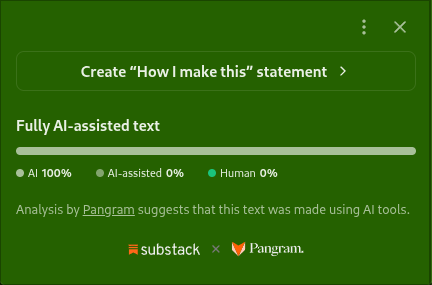
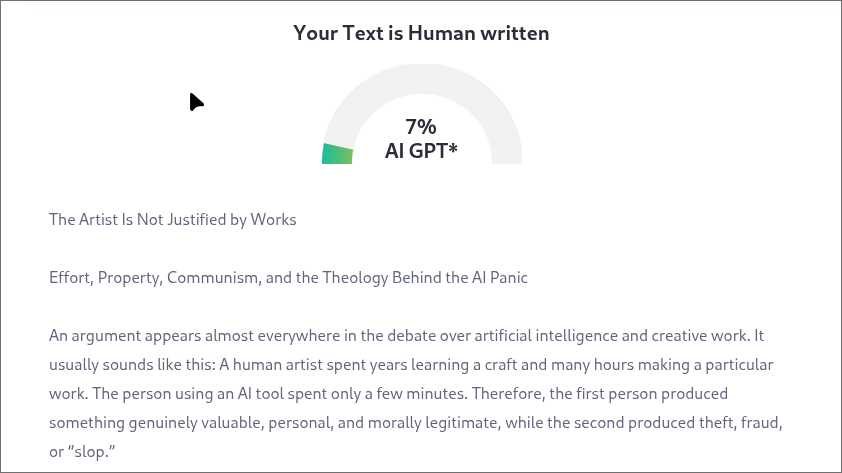
There is a reason I chose the ZeroGPT screenshot as the main image for this article. If labor truly were the end-all and be-all of creative authenticity, then surely the labor poured into this article would be recognized by the supposedly “99% accurate” AI-detection system Substack has implemented through Pangram. Unfortunately for both Substack and Pangram, my experiments over the past week have shown just how unreliable—and potentially fraudulent—those claims really are.
When the new Home Base—my own website—goes live, I will publish a full series documenting my findings and exposing Substack’s dirty little secret.
In the meantime, compare the ZeroGPT result with the score Substack and Pangram assigned this article while I was writing it. Then compare both of those with whatever score appears after publication. Look at the contradictions for yourself and ask one simple question: Why should anyone trust any of this?