A Look Back, A Look Ahead, and Why Your New Year's Resolution is Probably Idolatry
December 29, 2025

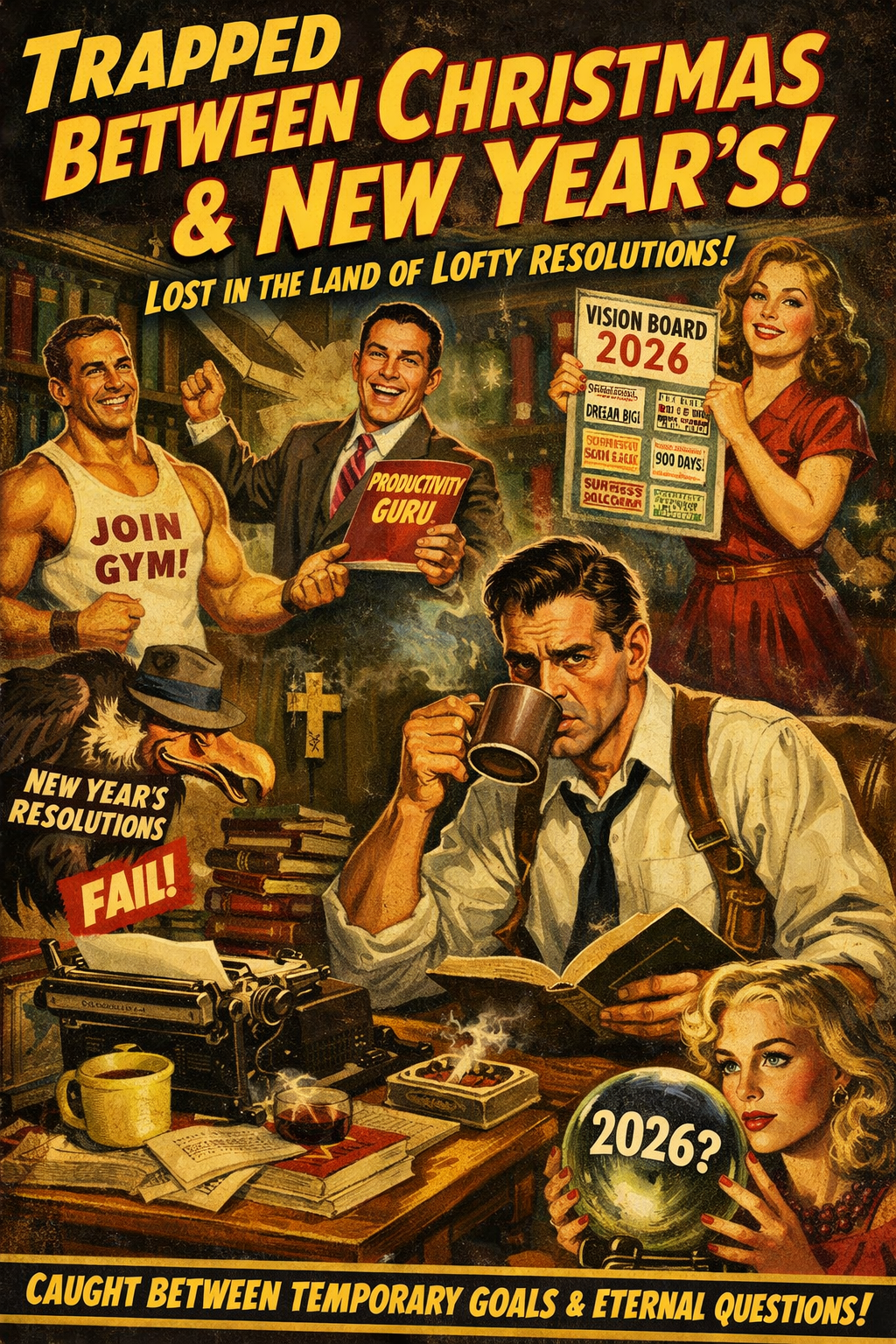
Here we are again—that strange twilight zone between Christmas and New Year’s Day when time moves like cold molasses and everyone pretends they know what they’re doing with their lives. The gym membership sales vultures are circling overhead, productivity gurus are hawking their latest “transform your life in 90 days” schemes, and somewhere in your social media feed, someone just posted their meticulously crafted vision board for 2026 with enough motivational quotes to choke a prosperity preacher.
I’m wondering how we got to the point where January 1st became our secular liturgical calendar’s most sacred day—complete with its own confessional rites (”I resolve to...”), penance (”I will work out every day”), and promises of transformation that would make a televangelst blush.
But before we dive into why your New Year’s resolution might be the modern equivalent of building a golden calf, let me take you on a journey through this wild year that was 2025, and what the Lord has in store as we stumble forward into whatever comes next.
Looking Back: What We Built in 2025
This year marked something of a turning point for everything I’ve been working on—not because I suddenly figured out the secret formula for creative success (spoiler alert: there isn’t one), but because I finally stopped apologizing for the work and started letting it speak for itself.
We launched this Substack with “This Might Be Nothing,” which proved to be prophetic in the most backwards way possible. Those early posts about creative anxiety, the technological terrors of AI detection tools, and my ongoing love-hate relationship with social media algorithms struck a nerve I didn’t expect. Turns out, a lot of you are wrestling with the same questions about authenticity, creativity, and whether any of this digital noise actually matters.
The series on horror and dark fantasy as Christian genres caused quite the stir—apparently suggesting that Christians can engage thoughtfully with stories about vampires and demons without losing their souls is still controversial in some circles. Who knew? But the conversations those posts generated were exactly what I hoped for: thoughtful, challenging, and grounded in Scripture rather than cultural prejudices.
“I Can’t Believe It’s Not Social Media” became our most shared piece, probably because it articulated what everyone’s feeling but nobody wants to say: most social media platforms are glorified slot machines designed to extract your attention and sell it to the highest bidder. The fact that this observation counts as profound social commentary says everything about where we are as a culture.
The YouTube channel—ah, the YouTube channel. RevBrandonWarr has been growing steadily, though “growing” is a relative term when you’re starting from basically zero and competing with every other content creator on the planet. But the sermon excerpts, theological discussions, and cultural commentary have found their audience.
There’s something deeply satisfying about diving into serious theological questions without the pressure to make everything bite-sized and algorithm-friendly. We’ve tackled everything from Gavin Ortlund’s ecclesiology to the theology of rebellion, and somehow people keep listening. Apparently there’s still an appetite for conversations that last longer than a TikTok video. (though, admittedly, I have done some of those types of videos as well)
The Personal Journey: Deeper into the Confessions
But the real story of 2025 hasn’t been the public content—it’s been the private study that feeds everything else. This year I dove deeper into the Lutheran Confessions than I have since seminary, not as academic exercise but as spiritual discipline. The Formula of Concord became my constant companion, its precision about the relationship between Law and Gospel cutting through the theological fog that tends to accumulate in our information-saturated age.
Reading the Smalcald Articles again reminded me why Luther’s theological courage was so necessary. His willingness to say “Here I stand” wasn’t stubborn individualism—it was submission to the authority of God’s Word over every human tradition that tried to muffle it. That principle has shaped every piece of content I’ve created this year, from the Substack posts to the YouTube videos to the songs I’ve been writing in my studio.
What’s Coming: Pulp Fiction and Kingdom Work
2026 is shaping up to be the year when several long-brewing projects finally see the light of day. Those pulp fiction novels I’ve been tinkering with—the ones that channel Raymond Chandler by way of Robert E. Howard with a dash of Lovecraft—are finally ready to emerge from my literary laboratory. I’m talking hard-boiled detective stories with theological underpinnings, sword and sorcery tales where the sorcery actually has spiritual consequences, and horror stories that acknowledge both the reality of evil and the greater reality of redemption.
Why pulp fiction? Because it’s honest about the human condition in ways that most modern “literary” fiction is too embarrassed to admit. Pulp doesn’t pretend that moral choices don’t matter or that evil is just misunderstood good. It presents a world where things like courage, sacrifice, and redemption actually mean something—which makes it perfect territory for Christian storytelling.
The first book of the New Year should be available by spring, Lord willing. Think of it as theology by other means—stories that don’t preach at you but that assume a universe where spiritual realities are as solid as physical ones.
Content creation will continue expanding in 2026, with more regular video content, deeper dives into confessional Lutheran theology, and probably more rants about why most “Christian” self-help books are baptized paganism. The goal isn’t to build an empire—it’s to contribute something worthwhile to the conversations that matter.
The New Year’s Resolution Heresy
Which brings me to the elephant in the room: the annual ritual of New Year’s resolutions and the deterministic dread that surrounds them.
Every year, we perform this strange liturgy of self-improvement, making promises to ourselves that we’ll somehow become different people simply because the calendar flipped over. We treat January 1st like a magical reset button, as if crossing an arbitrary date line could erase our fundamental nature or grant us supernatural willpower we didn’t possess on December 31st.
It’s a peculiar form of works righteousness dressed up in secular clothing. We convince ourselves that this time—this year—we’ll finally achieve the discipline, productivity, and self-control that have eluded us for decades. We’ll read more books, exercise daily, eat better, pray longer, and generally become the idealized version of ourselves that exists only in our imagination.
The problem isn’t wanting to improve—God knows we all need improvement. The problem is the underlying assumption that we can transform ourselves through sheer force of will, that we can be our own savior if we just try hard enough and follow the right system.
From a confessional Lutheran perspective, this is classic Law without Gospel—demanding perfection while providing no power to achieve it. It’s the spiritual equivalent of pulling yourself up by your own bootstraps: physically impossible and theologically bankrupt.
Christ has harsh words for this kind of thinking:
“And he said unto them, Take heed, and keep yourselves from all covetousness: for a man’s life consisteth not in the abundance of the things which he possesseth.” (Luke 12:15, ASV)
Most New Year’s resolutions, if we’re honest, are just baptized covetousness—wanting to possess a better version of ourselves, a more productive life, a more disciplined existence. We covet the Instagram-worthy version of our lives where everything is optimized and our morning routines look like productivity porn.
This is openly condemned by Scripture, as St. James warned:
“Come now, ye that say, Today or tomorrow we will go into this city, and spend a year there, and trade, and get gain: whereas ye know not what shall be on the morrow. What is your life? For ye are a vapor that appeareth for a little time, and then vanisheth away. For that ye ought to say, If the Lord wills, we shall both live, and do this or that.” (James 4:13-15, ASV)
The Other Ditch: Deterministic Dread
But there’s an equal and opposite error lurking on the other side of the road—the deterministic dread that assumes nothing we do matters, that the future is fixed and our choices are meaningless. This is the fatalism that looks at the calendar change and shrugs, “What’s the point? Nothing ever really changes anyway.”
This too is theological error. While we reject the idea that we can save ourselves through resolution and willpower, we also reject the idea that our actions are meaningless or that we’re just cosmic pinballs bouncing around randomly.
Scripture presents a different picture entirely:
“Watch therefore: for ye know not on what day your Lord cometh.” (Matthew 24:42, ASV)
Notice what Christ doesn’t say here. He doesn’t say, “Make elaborate plans for self-improvement.” But He also doesn’t say, “Nothing you do matters, so why bother?” He says watch.
Watching and Waiting: A Different Kind of Resolution
What does it mean to watch and wait in a world obsessed with goal-setting and self-optimization?
It means living with the constant awareness that this present moment—this conversation, this decision, this opportunity to love your neighbor—might be the last one you get. It means holding your plans lightly while taking your calling seriously.
When Christ asks whether He will “find faith on the earth” when He returns (Luke 18:8, ASV), He’s not wondering about global statistics or church attendance figures. He’s asking whether individual believers will be found faithful—not perfect, not optimized, not living up to their New Year’s resolutions—but faithful.
Faithfulness looks different from success. Success is about achieving your goals; faithfulness is about remaining committed to your calling regardless of outcomes. Success is measured by metrics; faithfulness is measured by character. Success can be photographed for Instagram; faithfulness usually happens when nobody’s watching.
This is why I’m suspicious of most goal-setting advice, especially the kind that promises to “transform your life” in whatever arbitrary timeframe the guru is selling this week. Not because goals are inherently wrong, but because they often become substitute saviors—false promises of a better future that keep us from engaging faithfully with the present.
Kingdom Work in 2026 and Beyond
So what does faithful content creation look like? What does faithful writing, faithful pastoring, faithful living look like in a world drunk on self-improvement and productivity optimization?
It looks like showing up consistently, not because you feel inspired, but because the work matters regardless of how you feel. It looks like telling the truth even when the truth is inconvenient for your brand. It looks like creating things that serve others rather than feeding your own ego.
For me, that means continuing to write—both fiction and non-fiction—that assumes a universe where spiritual realities matter more than material ones. It means preaching sermons that comfort the afflicted and afflict the comfortable, regardless of how that plays on social media.
It means treating every piece of content, every conversation, every opportunity to influence culture as a chance to point people toward Christ—not through heavy-handed moralizing, but through the quiet assumption that He is who He says He is and the world is what He says it is.
The Real Resolution
If I had to make one resolution for 2026, it would be this: to stop treating any human system—whether it’s social media algorithms, publishing industry trends, or cultural expectations—as if it were ultimate reality.
The real reality is this: Christ is risen. The Kingdom is both already and not yet. We are simultaneously sinner and saint. Today might be the last day or the first day of decades to come, and our job is to be faithful with whatever time we’re given.
And unlike every other promise we make to ourselves when the calendar flips, this one doesn’t depend on our willpower, our discipline, or our ability to maintain momentum when the initial enthusiasm fades.
Watching and Working
So as we stumble forward into 2026, I invite you to join me in a different kind of watching and waiting. Not the passive fatalism that does nothing because “God is in control,” and not the frantic activism that acts as if everything depends on us, but the faithful working that recognizes God’s sovereignty while taking our calling seriously.
Keep reading. Keep questioning. Keep creating. Keep showing up. Not because you’ve resolved to be a better person this year, but because the Kingdom is worth working for regardless of what year it is.
And when people ask you about your New Year’s resolutions, maybe point them toward something more sustainable: watching for opportunities to love your neighbor, waiting for Christ’s return, and working while it is day, because the night comes when no one can work (John 9:4, ASV).
The calendar will keep flipping, the gurus will keep selling transformation packages, and the culture will keep promising that this year will be different. But the Kingdom work remains the same: faithful presence in whatever moment we’re given, faithful witness to whatever truth we’ve been shown, and faithful hope in the One who promises that all things are working together for good.
“Watch therefore: for ye know not on what day your Lord cometh.” The best preparation for an uncertain future isn’t a better planner—it’s a faithful heart.