
Answer Not, Yet Answer: A Defense of Christian Polemics
How Proverbs 26:4–5 teaches us to fight for truth without becoming fools ourselves.

“Answer not a fool according to his folly,
lest thou also be like unto him.
Answer a fool according to his folly,
lest he be wise in his own eyes.”
— Proverbs 26:4–5 (ASV)
The Paradox that Governs Every Apologist
These two verses appear contradictory — and that’s the point.
Solomon isn’t confused; he’s describing a tension that every Christian defender of the faith must live within.
Sometimes silence is holy. Sometimes confrontation is required.
Wisdom lies in knowing which moment you’re in.
- Verse 4 warns against mimicking the fool — descending to his tactics, tone, or fallacies.
- Verse 5 commands us to answer him — lest falsehood parade itself as wisdom.
The polemical Christian lives between those verses.
And for Confessional Lutherans, this isn’t theoretical. It’s the air our theology breathes. Our Confessions are, in fact, polemical documents — written not to placate, but to defend and clarify.
“This is most certain, that where the Word of God is purely preached, there the devil ceases not to rouse up false teachers.”
— Apology of the Augsburg Confession, Preface
Silence, in such moments, is not peace. It’s permission.
Why Polemics Are Necessary
1. Because Error Kills
False doctrine is not an academic blunder; it is a soul-wound. The Reformers knew this.
Luther wrote:
“If I profess with the loudest voice and clearest exposition every portion of the truth of God except precisely that little point which the world and the devil are at that moment attacking, I am not confessing Christ.”
— Letter to George Spenlein, 1520
When Rome and the East distort the Gospel — whether by obscuring justification or mingling human merit with divine grace — we are not dealing with quaint disagreements. We are dealing with eternal stakes.
2. Because Silence Breeds Arrogance
“Answer a fool… lest he be wise in his own eyes.”
The Church that refuses to answer her critics allows error to grow smug. Polemics are a spiritual vaccine: unpleasant, but vital.
3. Because the Church Must Defend Her Children
Apologetics is not for personal victory but for the flock. Luther again:
“For the sake of the simple and the unlearned, I must speak, even if I thereby anger the great and learned.”
— Preface to the Small Catechism (1529)
Polemics are the shepherd’s crook turned staff of defense.
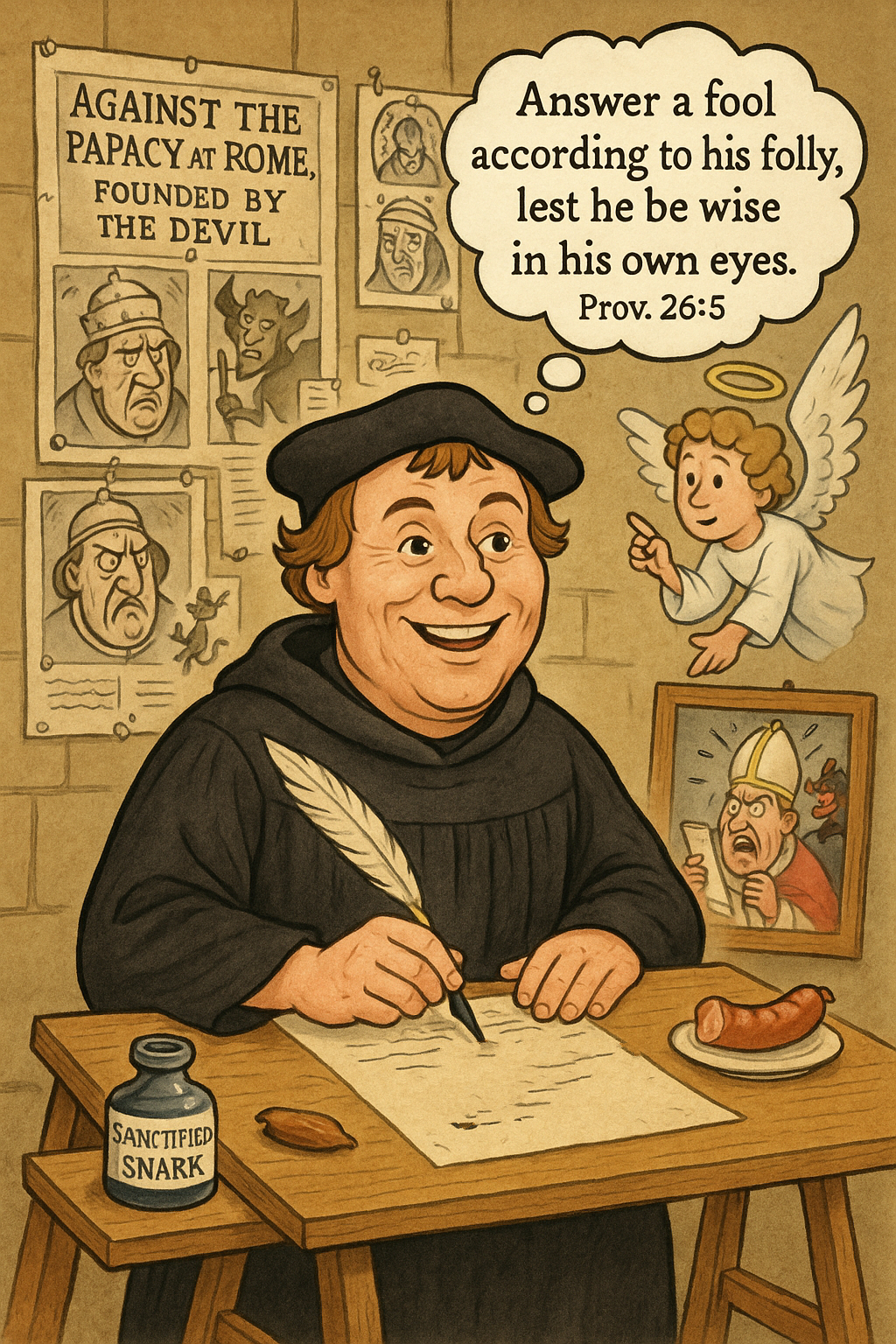
Proverbs 26 and the Art of Righteous Sarcasm
The pairing of Proverbs 26:4–5 is an inspired manual on tone.
1. Don’t become the fool (v.4).
Answer not according to his folly.
That means:
- Don’t slander, mock, or exaggerate the person.
- Don’t twist words to score rhetorical points.
- Don’t make sarcasm your substitute for substance.
The goal is to refute, not to perform.
2. Do expose the folly (v.5).
But when falsehood struts unchecked — when papal pretension claims infallibility, or when the Eastern mystic cloaks superstition in “tradition” — then silence is complicity.
The prophets mocked idols that could not move.
Elijah taunted Baal’s priests (“Cry louder! Perhaps he sleepeth!”).
Our Lord Himself called the Pharisees “whited sepulchres.”
That is sanctified sarcasm — not cruelty, but moral clarity.
3. The Two Proverbs as a Mirror
These verses are not contradictions; they are a mirror for the apologist’s conscience.
When to strike? When to refrain?
Christian polemics is an act of discernment — wielding words as scalpel, not club.
Luther: The Patron Saint of Godly Mockery
No one embodied this better than Dr. Martin Luther. His rhetoric could scorch, but always in defense of the Gospel.
He once wrote:
“Was [Jesus] abusive when he called the Jews an adulterous and perverse generation, hypocrites, and children of the Devil? … The truth, which one is conscious of possessing, cannot be patient against its obstinate and intractable enemies.”
— Luther’s Works, vol. 33: Career of the Reformer
Luther’s sarcasm was not petulant — it was prophetic. He believed words must bite when souls are at stake. He could flay a Roman theologian one moment and weep over the misuse of absolution the next.
“Reason is a whore, the greatest enemy that faith has.”
That line shocks modern ears. But Luther’s meaning is not to glorify ignorance — it is to expose the arrogance of reason when it presumes to judge revelation. It’s satire with teeth — a mirror turned on fallen intellect.
The Confessions: Polemic as Confession
Our very name — Confessional Lutheran — implies combat.
To confess is to say the same thing as God says, and thereby to contradict the devil.
The Smalcald Articles state bluntly:
“Of this article [Justification] nothing can be yielded or surrendered, even though heaven and earth and whatever will not abide should sink to ruin.”
That’s not negotiation. That’s war-time declaration.
The Book of Concord itself is not neutral theology — it is organized rebuttal.
To be Lutheran, then, is to be polemical in principle, but with the restraint of Proverbs 26. We fight — but not like fools.
The Fathers Were Not Gentle Either
Origen’s Contra Celsum answers pagan mockery with logic and wit. He dismantles his opponent’s argument piece by piece and even ridicules its absurdity. Ignatius of Antioch called heretics “ravening dogs.” Jerome’s letters are theological fistfights written in ink.
The early Fathers did not mistake sharpness for sin. They believed love sometimes sounds like thunder.
St. John Chrysostom himself once said:
“He who rebukes in love is harsher than he who flatters in hatred.”
Polemics are not hatred. They are love sharpened by conviction.
Practical Rules for Sanctified Snark
1. Target heresy without causing friendly fire.
Mock the lie, while also knowing a soul may yet repent.
2. Ground every barb in Scripture.
A jest without the Word is cruelty; a jest wielded by Scripture is surgery.
3. Remember your own sin.
Luther knew he was a beggar too. The moment the polemicist forgets that, his sarcasm curdles into pride.
4. Context is king.
Don’t turn pastoral counseling into an X/Twitter debate. There’s a time to thunder and a time to whisper.
5. Aim for repentance, not applause.
If your sarcasm earns laughs but no conviction, you’ve missed the mark.
Against Rome and the East: The Confessional Edge
To Rome, which obscures the Gospel beneath sacramental bureaucracy, we must answer.
To the East, which swaps clarity for mysticism and tradition for Scripture, we must answer.
To modern Protestants who trade confession for relevance, we must answer.
But we must never answer according to their folly.
We answer with truth — and, when the moment calls, with a grin sharp enough to cut error down to size.
As Luther put it:
“One should not only stand up for the truth, but also drive away the wolves, so that the sheep may not be devoured.”
The Final Word: Answer as the Cross Allows
The Christian polemicist’s weapon is not rage but cruciform conviction.
We fight because Christ fought first — against the devil, the world, and our flesh.
We mock idols not for sport but because they enslave souls.
So answer not — when the fool’s noise only drags you down.
But answer — when silence would make the fool think himself wise.
That tension is the narrow way of the apologist.
To walk it requires Scripture in the mind, humility in the heart, and — occasionally — a sanctified smirk.