
Guns, the Magdeburg Confession, and Why Christian Fiction Can Bear Arms
A brief treatise on Self-Defense Doctrine in Christian Pulp Fiction

Introduction: Violence, Vocation, and Fiction
Every Christian author who dares to write in genres like noir, fantasy, or pulp has faced the question: “Why so much violence?” The charge often comes that portraying gunfire, swordplay, or bloodshed is little more than glorification of sin. But to leave the matter there is to misunderstand the Christian doctrine of vocation and the Confessional Lutheran teaching on the Fifth Commandment.
Fiction that depicts lawful defense of life and property is not indulgence in cruelty. It is catechesis in narrative form. From the pulp noir of Children of the Black Veil to the dark fantasy of Ezekiel Creed, the trigger is never pulled in lust or vengeance, but in service of neighbor-love. To understand why, we must turn to our own heritage: the Magdeburg Confession and the Lutheran Confessions.
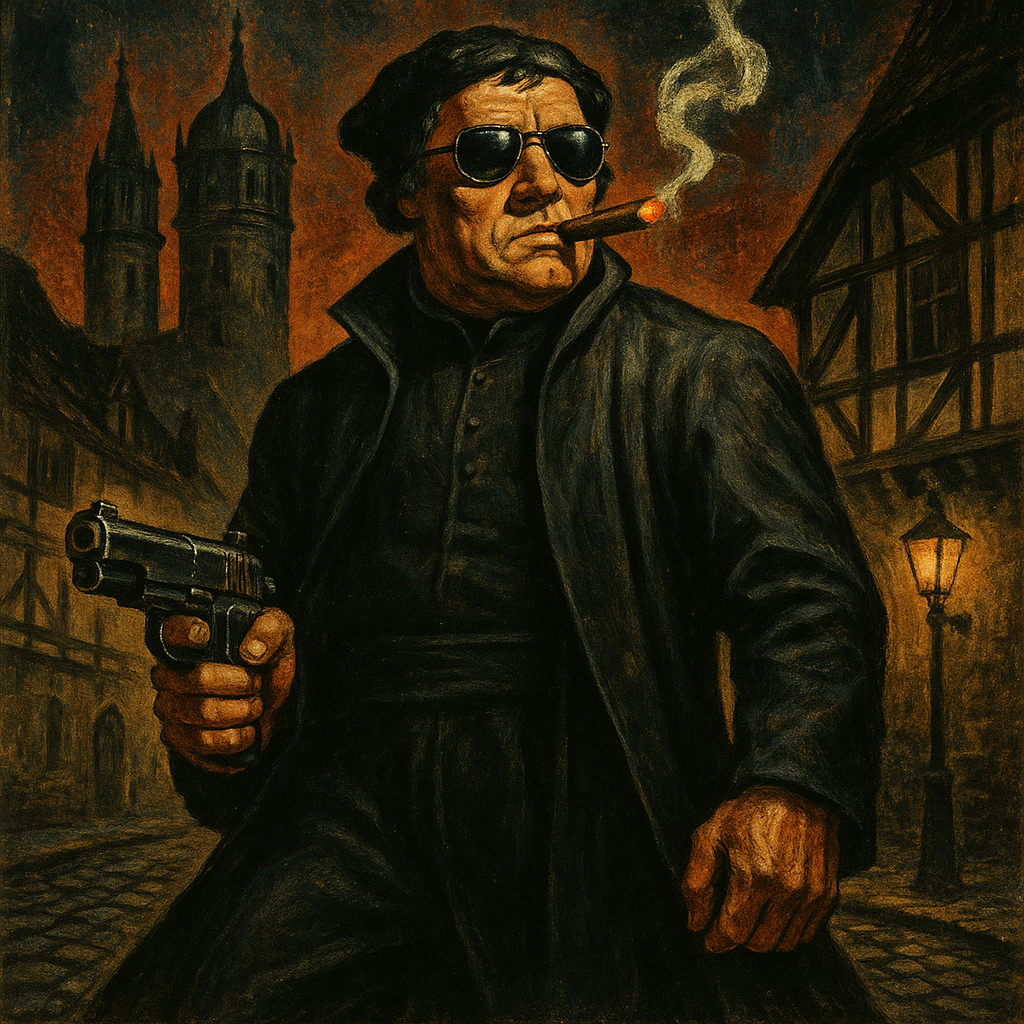
The Magdeburg Confession: Resistance as Neighbor-Love
In 1550, the pastors of Magdeburg issued a bold confession against Emperor Charles V. His armies sought to impose the Augsburg Interim, a compromise that would have smothered the Reformation. The pastors declared:
“When the higher magistrate persecutes with force and arms, the lower magistrate is bound by God’s command to resist, and even to defend his subjects.” (Magdeburg Confession, Preface, 1550)
This was no call to reckless rebellion. The confessors carefully distinguished degrees of tyranny. Only when the magistrate becomes a destroyer—hostis, not princeps—is resistance required. In such cases, love of neighbor binds lesser magistrates to defend their people, even with the sword.
The Confession rests on Acts 5:29: “We must obey God rather than men.” Here the Lutheran tradition anchors armed defense not in hatred but in obedience and love. Resistance is not a carnal grasping at power but a refusal to let the innocent be devoured.
The Fifth Commandment: More Than “Do Not Kill”
Luther’s Large Catechism offers a powerful interpretation of the Fifth Commandment:
“Therefore it is God’s ultimate purpose that we suffer harm to befall no man, but show him all good and love; and, as we have said, not only that we do not hurt our neighbor in his body, but that we do him no injury or evil, but show him all good and love.” (LC I.189–190)
To keep the Fifth Commandment is not simply to refrain from murder. It is to actively preserve life, to shield our neighbor from danger, to intervene when harm threatens. Luther’s explanation closes the door on a pacifism that refuses to act while others perish.
In fact, he continues:
“If you see anyone suffer hunger and do not give him food, you have let him starve. So also, if you see anyone condemned to death or in similar distress and do not save him, although you have means and ways to do so, you have killed him.” (LC I.191–192)
Silence in the face of murder is murder by omission. To allow violence when we could stop it is to break the very commandment we thought we kept.
Bearing the Sword in Vocation
Paul writes in Romans 13:4 (ASV): “For he is a minister of God to thee for good. But if thou do that which is evil, be afraid; for he beareth not the sword in vain: for he is a minister of God, an avenger for wrath to him that doeth evil.”
The civil use of the sword is not demonic but divine. Likewise, the private individual—when faced with direct threat to family, neighbor, or the innocent—may lawfully bear arms. The key is vocation. A Christian does not kill because he delights in death, but because his neighbor’s life is entrusted to him.
Thus guns in fiction, when wielded rightly, are not symbols of rebellion against God but of vocation under God.
Guns in Pulp Noir: Jonathan Brooks and the Theology of Resistance
In Children of the Black Veil, Jonathan Brooks, an ex-cop turned investigator, moves through Chandler City’s rot and shadows. He carries a gun, yes—but not to glorify crime or to revel in vengeance. Brooks is a man who has seen authority corrupted, who stands in the gap where lawful magistrates refuse to act.
Like the pastors of Magdeburg, Brooks recognizes that when rulers become destroyers, someone must resist. His pistol is not a tool of chaos but a last line of defense. Every bullet fired in the story is weighed against the question: “Am I preserving life or destroying it?”
Readers may recoil from the violence, but that recoil is part of the catechesis. The story does not revel in cruelty but dramatizes the moral weight of resistance.
The Sword of Creed: Dark Fantasy and Neighbor-Love
Ezekiel Creed, warrior-priest, strides into dark caverns with steel in one hand and Scripture in the other. His world is one of demons and cults, but his violence is never arbitrary. It is the necessary resistance of light against darkness, of love against destruction.
When Creed lifts his blade, he embodies Luther’s explanation of the Fifth Commandment. He strikes not for glory but for the preservation of the innocent. His fantasy battles are allegories of real-world neighbor-love. To stand idle while evil devours is to abandon the commandment. To strike in love is to fulfill it.
Fiction as Catechesis in Action
The Lutheran Confessions never present the Christian life as sanitized or safe. They are blunt about sin, tyranny, and suffering. Christian fiction, if it is honest, must also depict such realities. But it must also show how God calls us to live within them.
By writing guns and swords into pulp stories, we are not baptizing bloodlust. We are confessing that love of neighbor sometimes requires costly defense. We are illustrating what the Magdeburg Confession declared: when evil rises, Christians must not abandon the weak.
Fiction becomes catechesis. The story is a parable of vocation. The character’s hand on the trigger is the reader’s meditation on the Fifth Commandment.
Avoiding the Snare of Glorification
Yet let us be clear: not all depictions of violence are lawful. Christian authors must discern. Gratuitous gore, indulgence in cruelty, or reveling in slaughter is sin in ink. We do not imitate Tarantino; we write under the cross.
What distinguishes righteous fiction from sinful fiction is whether the violence is tethered to vocation and neighbor-love. Jonathan Brooks firing his revolver to save a child is not the same as a hitman’s joy in killing. Ezekiel Creed’s blade raised against a demon is not the same as a warlord’s lust for conquest.
Christian fiction must never confuse the two.
Conclusion: Hammer and Rose
The Magdeburg confessors risked everything to defend their people. Luther’s catechism calls us to shield our neighbor from harm. Scripture proclaims the civil use of the sword as God’s ordinance.
When pulp noir heroes or dark fantasy warriors bear arms in my stories, they do so in the service of these truths. Their violence is not chaos but vocation. Not hatred but love. Not glorification but catechesis.
In a fallen world, neighbor-love sometimes requires hard steel as well as soft mercy. To write this into fiction is not compromise but confession. It is the hammer and the rose—strength to break evil, love to protect the weak.
If the hammer and rose resonate with you, carry it beyond the page. The Hammer & Rose Merch Store is where theology meets bold design—shirts, mugs, and more that confess the faith without compromise. Every piece is a reminder that strength and mercy belong together in Christ. You can find it here.