
I Can't Believe its Not Social Media
Random complaints and musings on Social Media style marketing for creatives

My thought process for this post was to give an honest review of my experience on Substack as when this post (or blog or email thing…whatever Substack calls it) I will have been on Substack for right around a month. I know that the online world is not going to move over for me in a month on Substack especially some poor guy working full-time in Family Services while Pastoring a Church, juggling sermon prep and pastoral visits between case files and mandatory reporting paperwork. However, I was sold on the prospect of Substack due to the hype surrounding it from more experienced users who spoke about it with the reverence usually reserved for discovering fire or inventing the wheel.
"It'll change everything," they said. "Your words will finally find their audience," they promised. And like a desperate songwriter hoping his next track will be the one that connects, I believed them.
Sure, there is the oddity of writers writing about writing for an audience of other writers which I was keenly aware of and warned about before joining. It's the digital equivalent of playing a gig where the only people in attendance are other musicians, all waiting for their turn at the mic. But the consensus seemed to be that the algorithm on Substack was not as brick-walled as places like X, Instagram, or, Lord help me, TikTok—a platform that makes me feel approximately 437 years old every time I open it. I was told it is easy to grow on Substack as long as I could provide a decent amount of interaction, like some sort of content-creating hamster running on a wheel of engagement metrics. Plus, it was a way to get an email list up and running without having to set that up separately from the social media side of marketing, which appealed to the part of me that still struggles to program my coffee maker.
I was sold the bread and butter of social media and email marketing that was Substack. The digital promised land flowing with readers and subscribers. Turns out it is more like rice patties and "I can't believe it's not butter!"—a pale imitation of the nourishment I was expecting. The platform has all the empty calories with none of the satisfaction. Substack should seriously look into adopting the tagline "I can't believe it's not social media!" The irony being that it is exactly like any other social media site in the worst ways, being nothing but a cheap knockoff, like when you order something amazing online and receive a box containing what appears to be its malnourished cousin assembled in someone's garage.
Much like my early songwriting attempts that sounded suspiciously like Bob Dylan with a head cold, Substack promises originality but delivers the same old tune with slightly different lyrics. And here I am, a pastor who should know better than to chase false idols, still refreshing my stats page like it might suddenly reveal the path to digital salvation.
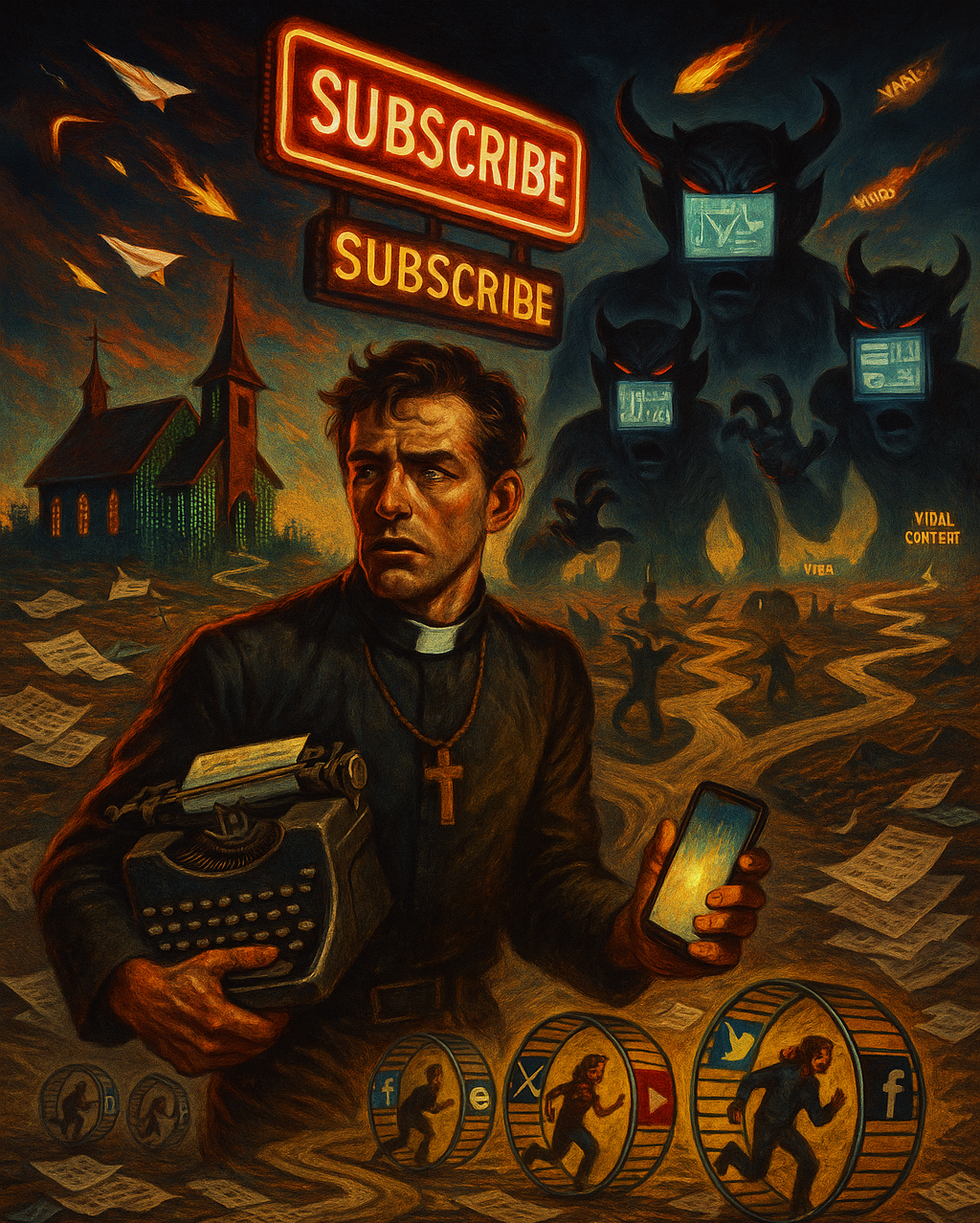
Again, I don't expect massive numbers in such a short timespan, but the hype is, well, just that… its hype. With a side order of zero interactions and a dessert of crushing disappointment. The irony of this rant is that, based on previous performance of my other posts on this platform, it's going to end up as another instance of me screaming into the void—a void that doesn't even have the courtesy to echo back.
This leads me to the question that haunts every creator at 2 AM: why bother? I have built modest audiences for my music, podcast, and other works. Folks who actually engage with posts or tune in when I dive into theology on "The Bookcase Behind Me." But these small victories have always come at the expense of the love of the art in order to bend to the almighty algorithm—that digital deity demanding sacrifices in exchange for a few measly views.
You follow every piece of (good) advice to grow on any social media platform and get next to nothing. Not even crickets. Crickets would be an improvement. I've spent hours optimizing posts, choosing the perfect thumbnail for YouTube videos, and crafting clever captions for a new release, only to watch them sink into digital obscurity faster than my high school rock band's demo tape.
I am told on the one hand that my style in any creative avenue is simultaneously too broad ("You can't be a pastor AND a fiction writer!") and too narrow ("Your theological discussions are too niche!") to grow an audience. It's like being criticized for wearing pants that are somehow both too tight and too loose at the same time.
I have next to no money to pay anyone for their super-awesome-I'm-gonna-help-you-grow training courses which are just microwaved content I could get on YouTube for free. These digital snake oil salesmen promising thousands of followers for just $499.99 (but wait, there's more!) are the modern equivalent of those ads in the back of comic books selling x-ray glasses. Unless someone already has a decent sized audience, there is little to nothing a freshly squeezed baby creator can do to grow. At least not in the way everyone tells you is the way you should grow—which usually involves selling a piece of your soul and pretending to be someone you're not. And to keep posting like that three times a day for the privilege of no one interacting with your latest post? It's digital masochism at its finest. You're essentially shouting into the void, watching your carefully crafted thoughts disappear into the algorithmic abyss without so much as a courtesy like.
It's like throwing a party where you've spent hours decorating, cooking elaborate finger foods, and creating the perfect playlist, only to have absolutely no one show up—except maybe that one random account from halfway across the world that somehow found your post at 3 AM their time and left a cryptic emoji that might be supportive or might be mocking you. You'll never know. And yet there you are, the next day, doing it all over again, scheduling your posts at the supposedly "optimal times" that some social media guru swore would triple your engagement. Spoiler alert: they don't.
Even this post is the antithesis of how to grow on social media because I sound like a whiney millennial frustrated at something that is not a real issue. The experts would crucify me for this—writing paragraphs of self-pitying text instead of crafting a punchy, algorithm-friendly hook with a perfectly posed photo of me looking thoughtfully into the distance. They'd tell me I should be sharing "5 Quick Tips to writing Success!" or "How I Balanced Ministry and Art (Number 3 Will Shock You!)." Instead, I'm committing the cardinal sin of social media: authentic complaining.
The irony isn't lost on me. Here I am, a pastor who spends his Sundays preaching eternal truths, getting bent out of shape over fleeting digital validation. I've laid down albums, penned tunes that folks genuinely enjoy, unleashed tales that were imprisoned in my mind forever, and run a theological podcast, yet somehow I'm allowing the scarcity of tiny digital affection symbols to establish my artistic value. My bandmate who passed away in 2013—the one who inspired "All the Good Times Are Passed and Gone"—would probably give me that look, the one that silently communicated "seriously, dude?"
But there's something viscerally human about wanting your creative work to matter to someone besides yourself and your mom (who, bless her heart, still thinks everything I do is brilliant). When you pour your soul into something—whether it's a sermon, a song, or even just a stupid social media post—you want it to land somewhere fertile, not just evaporate into the digital ether like morning dew.
So for all of my complaining, the worst thing to do is to stop now. For all the millennial whining, the true deathnail isn't the thousand times the algorithm deals me a fatal blow; it's the fact that the fatal blow isn't all that fatal. If I didn't post this stuff, I would go insane thinking about how much I want to say. The ideas would just ricochet around my skull like a hyperactive pinball, lighting up corners of my brain at 3 AM when I should be sleeping, not contemplating the bridge of a song or the theological implications of some obscure Biblical passage.
The creative urge doesn't politely knock—it kicks down the door of your consciousness and refuses to leave until acknowledged. I've tried ignoring it before. Back in 2017, I took a "social media fast" that was supposed to be enriching. Instead, I found myself scribbling lyrics on church bulletins and recording voice memos between pastoral visits. My notebook became a pressure valve for thoughts that had nowhere else to go.
That's the dirty little secret about creativity that Instagram-filtered "artist lifestyle" posts won't tell you: sometimes you create not because you're inspired, but because you're haunted. The songs that became the "Basement EP" weren't recorded because I thought they'd set the world on fire—they were recorded because they wouldn't leave me alone until I gave them form.
So, regardless of metrics, algorithms, or the crushing silence that sometimes follows hitting "post," I will say it. I'll keep recording those songs, writing those stories that echo the pulp magazines I loved as a kid, and discussing theology that challenges comfortable assumptions. Not because I'm guaranteed an audience, but because the alternative—keeping it all bottled up—feels like a kind of death that's far more permanent than any algorithm could inflict. I'll keep putting it out there and hope it will eventually get me where I need to be, even if I'm not entirely sure where that is yet.
"Come now, ye that say, To-day or to-morrow we will go into this city, and spend a year there, and trade, and get gain: whereas ye know not what shall be on the morrow. What is your life? For ye are a vapor that appeareth for a little time, and then vanisheth away. For that ye ought to say, If the Lord will, we shall both live, and do this or that." -James 4:13-15