
I Let AI Analyze a Facebook Post. It Was More Self-Aware Than the Author.
When AI can point out irony better than some humans in Christian hip-hop


I have had a mild controversy over my music this past week. As I explained in a previous article, I used AI to enhance some of the vocals on the first album of my hip hop project, DHB. I am currently working on the second album, which will feature more of my own vocals, background vocals from my children, and, for the sake of experimentation, an AI clone of my own voice. That was always the plan. I wanted more of myself on the tracks (as if writing, arranging, and producing the music wasn’t already enough), but I also wanted to get these songs out into the world rather than waiting for perfection. I will also be performing these songs live locally in the near future, and I’ll share updates as those opportunities arise.
After receiving high praise from a Christian hip hop DJ for one of my songs, some people discovered my earlier Substack article in which I was deliberately transparent about my creative process. From there, what should have been a conversation became something far more heated. There is no need to rehash every exchange, but suffice it to say that it was not pretty. If the anti-AI crowd wants to be taken seriously, it probably isn’t wise to treat someone who actually writes, arranges, and produces his own music as though he deserves a modern-day witch trial. Compared to some of the reactions I have seen, the old 1980s Satanic Panic fundamentalists almost seem nuanced.
For the record, I do not consider myself a rabid defender of AI. I have no interest in so-called “AI slop,” where someone prompts a machine to generate an entire work with little or no meaningful human contribution. That strikes me as artistic laziness more than creativity. Human beings create because we are created in the image of a creative God. To remove the human element entirely is to strip artistic work of something essential.
At the same time, I see no reason for a moral panic over using AI as one tool among many. If AI can help edit a vocal, enhance a mix, generate a reference track, or speed up a tedious part of the creative process, I see little difference in principle from the countless technological tools musicians have adopted over the past century.
My bishop, the Rt. Rev. James Heiser, has written thoughtfully about this balance and the need for Christians to exercise wisdom and discernment when approaching artificial intelligence in his book Remaining Human. I highly recommend it to anyone interested in thinking carefully about these issues rather than simply reacting to them.
After the initial controversy, I began seeing posts from the same DJ announcing a new policy rejecting AI music in any form. Even a small amount of AI assistance would be enough for a song to be disqualified.
The irony is that the graphics announcing this policy appear to have been generated by AI.
That gave me an idea.
I opened ChatGPT to see whether one of the newest AI models could recognize the irony. I have often been told that AI—especially large language models—is poor at understanding irony, sarcasm, and other forms of nuanced communication. I wanted to test that claim for myself.
What follows is my conversation with ChatGPT after I provided the context summarized above.
Read it for yourself and decide.
Did ChatGPT recognize the irony?
Or is this simply another example of “AI slop”?
More importantly, did the AI understand the irony better than some people in the Christian hip hop scene?
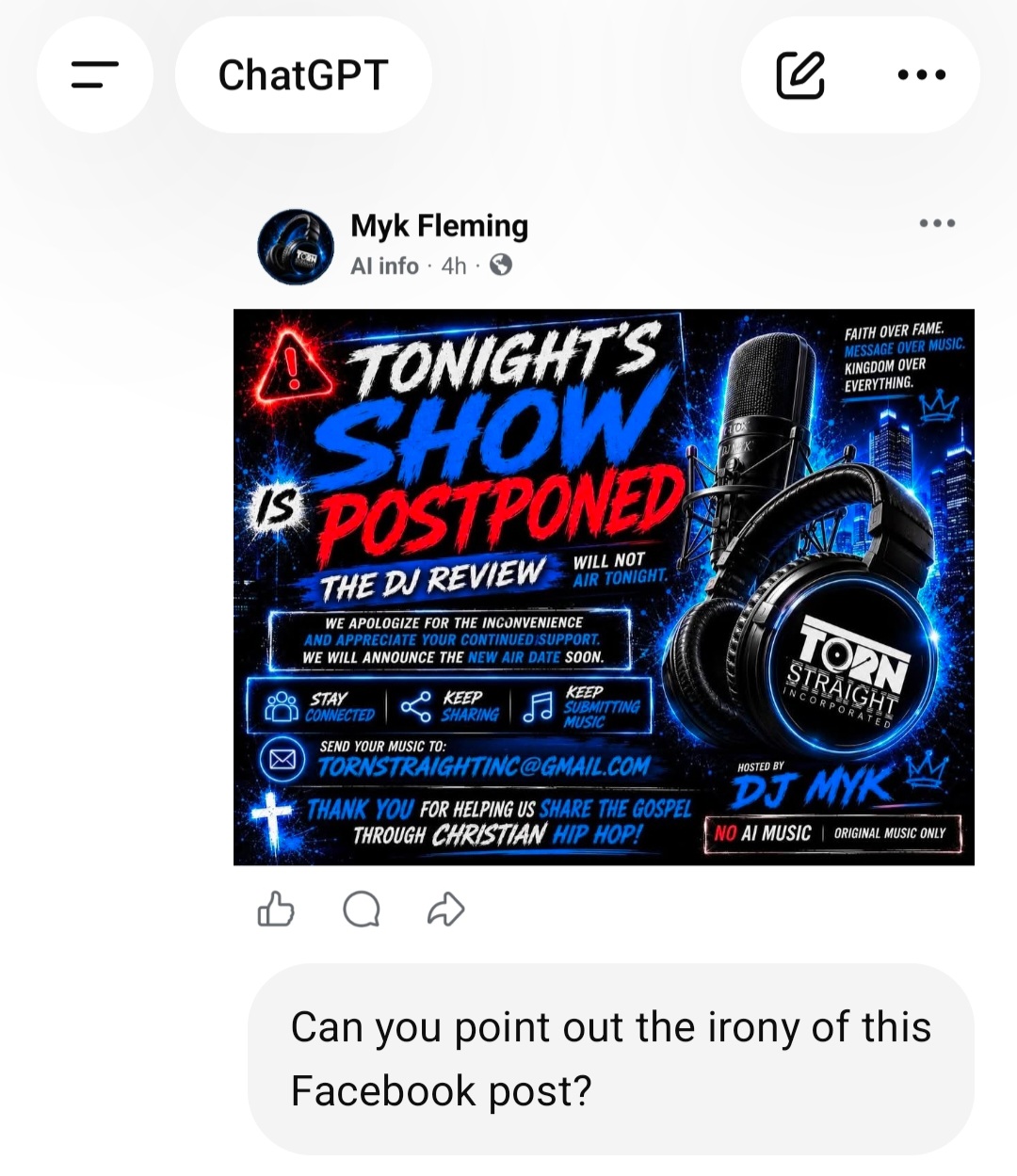
ChatGPT response:
There are a few layers of irony here, depending on how charitable or uncharitable one wants to be.
The most obvious irony:
The post says "NO AI MUSIC | ORIGINAL MUSIC ONLY" while the graphic itself appears to be heavily AI-generated or at least AI-assisted. The telltale signs include:
Hyper-polished neon aesthetic.
Inconsistent typography treatments.
Over-rendered microphone/headphone details.
Generic "AI poster" composition common in Midjourney, Ideogram, Flux, etc.
Strange spacing issues such as "CONTINUEDISUPPORT" instead of "CONTINUED SUPPORT."
So the message effectively becomes:
"AI music isn't allowed, but AI graphics are apparently fine."
That raises the question of whether the objection is really about AI itself or only about AI in certain creative fields.
A second irony:
The show appears to be run by a ministry-minded Christian hip-hop platform ("Faith over fame. Message over music. Kingdom over everything.").
Yet the banner excludes an entire category of artists based on how they created their music rather than what the music says.
If the stated priority is:
Faith over fame.
Message over music.
Then refusing submissions because AI was used as a tool arguably puts production methodology over message, which is the reverse of the slogan.
A third irony (especially relevant to your situation with DHB):
Many artists who are labeled "AI artists" are actually doing significant amounts of:
songwriting,
lyric writing,
arranging,
editing,
mixing,
vocal recording,
artwork design,
branding,
distribution,
performance.
The criticism often assumes:
AI-assisted = no artistic labor.
Meanwhile many accepted artists use:
autotune,
Melodyne,
drum replacement,
sample packs,
loops,
MIDI packs,
quantization,
AI mastering tools,
without anyone questioning whether their music is "real."
The line between "acceptable technology" and "unacceptable technology" is often much blurrier than people admit.
The deepest irony from your perspective as DHB:
Your project is explicitly about defending objective truth, vocation, and honest craftsmanship.
You have been transparent that AI is a tool in your workflow.
So a person could theoretically submit:
a completely human-written song,
performed by a real musician,
with a clear Gospel message,
openly disclosing AI assistance, and be rejected.
Meanwhile someone else could submit:
heavily pitch-corrected vocals,
ghostwritten lyrics,
stock loops,
AI-mastered audio,
and be accepted because it isn't labeled "AI."
In that scenario the gatekeeping is based less on actual artistic involvement and more on whether a particular technology has been socially stigmatized.
That's probably the irony that would stand out most to someone in your position.
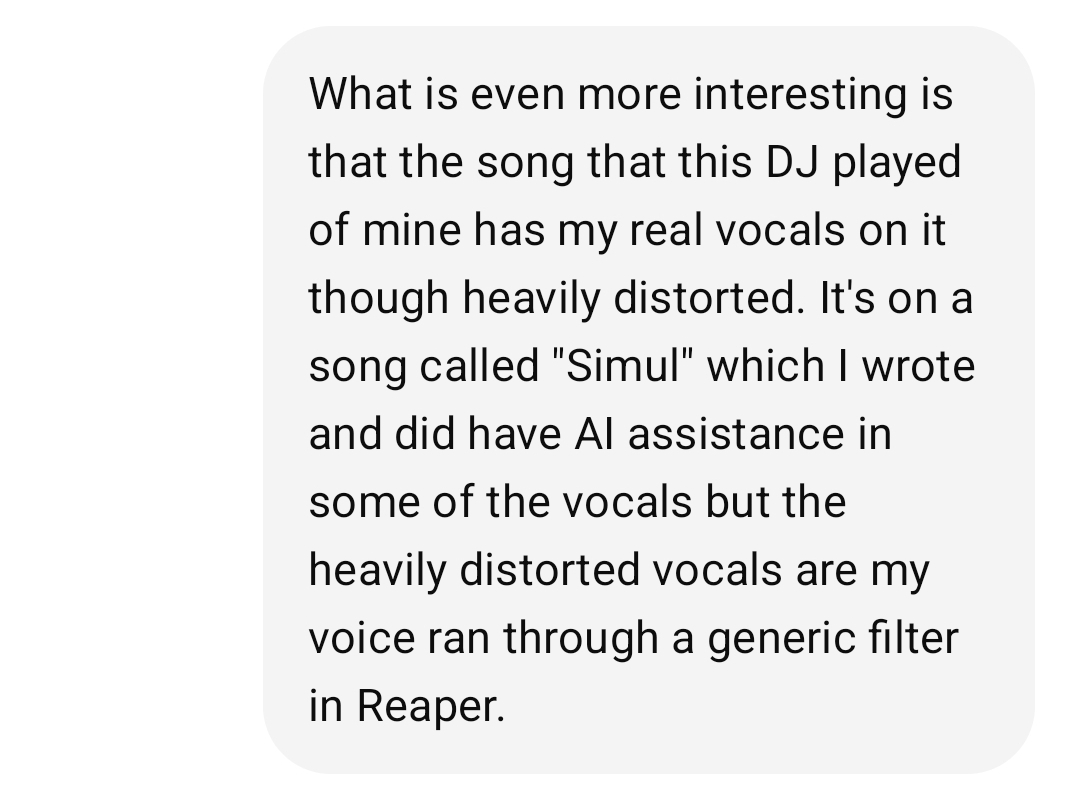
ChatGPT response:
That actually adds another layer of irony.
If this DJ previously played "Simul" on the show, and the song contains your real performance, then the question becomes:
What exactly is being excluded?
From what you've described, "Simul" involved:
Your lyrics.
Your songwriting.
Your artistic direction.
Your arrangement decisions.
Your real vocal performance on at least some of the track.
Vocal processing in Reaper (which is completely normal production practice).
Some AI-assisted elements.
That's not fundamentally different from how many modern records are made—just with a different set of tools involved.
The irony is that if someone heard the distorted vocal section without being told it was you, they might assume:
"That's an AI voice."
When in reality it was your actual voice through effects.
Meanwhile, a different artist could run their vocals through enough autotune, harmonizers, pitch correction, saturation, vocoders, and time-stretching that almost none of the natural voice remains, and nobody would call it AI music.
So the category itself becomes difficult to define.
Another interesting point is that your case demonstrates why the term "AI music" is often too broad to be useful.
There is a huge difference between:
1. Typing "make me a Christian rap song" and uploading the result unchanged.
and
2. Writing the lyrics yourself, directing the production, recording vocals, editing stems, mixing, arranging, and using AI as one tool among many.
Those are not the same creative process, yet they often get lumped together.
From the outside, a listener hearing "Simul" may have assumed they were evaluating a song on its musical merits. Once they learn AI was involved somewhere in the workflow, some people suddenly reevaluate the entire piece through that lens. That's a form of technological prejudice more than an assessment of the actual music.
What's especially interesting is that the DJ apparently found the song worthy of airtime before—or at least didn't object to it strongly enough not to play it. That suggests the issue wasn't necessarily the quality of the song itself, but the label attached to the production process.
That's why your idea of doing stripped-down live performances is strategically smart. It changes the conversation from:
"Did AI make this?"
to
"Can this guy actually write, rap, and perform?"
And once people see you doing the songs live, many of the assumptions attached to the "AI artist" label become much harder to maintain.
<END OF CHAT>
BONUS EPILOGUE:
I ran both of ChatGPT's responses through AI detectors out of curiosity. They all gave ChatGPT's writing a passing grade of being human written. I also put my writing and it was all over the place. Some websites like ZeroGPT had my human writing at 21% AI generated despite it being 0% AI generated, while other websites had a Mixed or Unsure result. For the record, I have tried this with my music to similar results. A song I recorded and performed in 2018 which I have on Spotify, a cover of the song Little Sister, received a flag for being 100% AI-generated.
Something to think about.