
Launching "Ezekiel Creed: Tribe of Dust and Blood"
A Fantasy of the Cross and the Sword

The day has come. Ezekiel Creed: Tribe of Dust and Blood is now live in both paperback and ebook on Amazon. After months of work, editing, design, and prayer, the story is finally ready to stand in the hands of readers.
But behind the release is something deeper than just a tale of swords and demons. Ezekiel Creed was born out of both pulp inspiration and Confessional Lutheran theology.
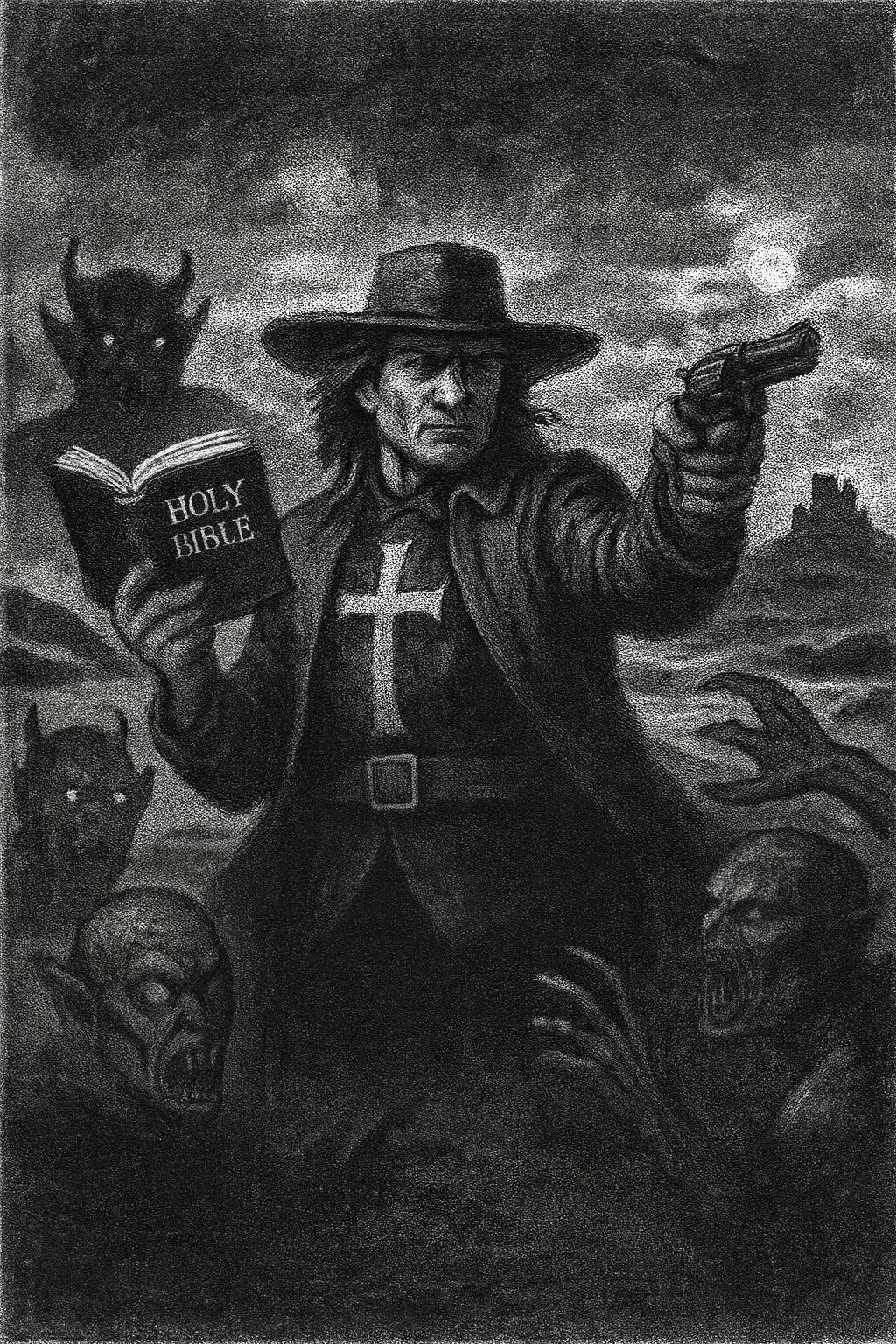
The Inspiration: From Solomon Kane to Ezekiel Creed
Robert E. Howard, creator of Conan the Barbarian, also gave the world Solomon Kane, a wandering Puritan with sword and pistol in hand. Kane’s grim determination, his lonely trek through a dark and haunted world, and his relentless pursuit of evil shaped my imagination.
But Howard’s Kane, for all his steel, never bore the full Theology of the Cross. His world was haunted by fate, shadows, and grim inevitabilities; and while the theology of the cross is present in Howard’s stories, I needed something more explicit, showing Christ who trampled death by death. My aim with Ezekiel Creed was not to copy Kane but to give flesh and bone to a warrior whose strength comes only from Christ crucified.
Where Howard left off, I sought to fill in with the confession of the Church: that evil is not merely shadow and fate, but the rebellion of demons already judged at the Cross.
The War Every Christian Fights
Christians are not spectators in a neutral world. Scripture is clear:
“For our wrestling is not against flesh and blood, but against the principalities, against the powers, against the world-rulers of this darkness, against the spiritual hosts of wickedness in the heavenly places.” (Ephesians 6:12, ASV)
Ezekiel Creed is not a fantasy escape. He is a mirror of the Christian man called to war daily against the devil, the world, and his own flesh.
The Augsburg Confession confesses this reality:
“For the devil, who is a liar and murderer, entices and impels men to sin by his lying and murderous arts” (AC II.1).
Ezekiel Creed embodies this truth. His mace, his blade, and his crucifix are not mere props—they are pulp-flesh depictions of the reality every Christian lives in their baptismal vocation: “to renounce the devil and all his works and all his ways.”
A Glimpse Into the Novel
From the opening pages, Ezekiel Creed’s journey sets the tone:
“He looked less like a man and more like a tattered sermon, torn from the pulpit and flung into the wild… Yet Ezekiel Creed, bowing his soul before eternity, did not go silently… Through purple lips and the rattle of breath, he prayed again: ‘He that dwelleth in the secret place of the Most High shall abide under the shadow of the Almighty.’”
Creed is not just a warrior. He is a preacher in black, carrying the Word into places where idols still demand blood and demons wear the faces of gods. His calling, as he says to the chieftain Ur-Kaleb:
“I am called to a specific task. Ordained as a minister… I am sent to the wilderness, to places where darkness has taken root… I bring the Lord to places of darkness, but I am not called to stay. I plant, others water, but God gives the growth.”
This is pulp fiction with the heartbeat of the Great Commission.
The Confessional Shape of the Story
Where Solomon Kane thundered with fate, Ezekiel Creed proclaims the Cross.
The Formula of Concord declares:
“Christ has overcome the devil, destroyed hell, and taken from the devil all his power.” (FC SD VIII.11)
This is the marrow of Ezekiel Creed’s battles. Every swing of his blade, every psalm he shouts in the snow, is anchored in the reality that Christ has already triumphed. Creed bleeds, but his blood is testimony. His scars, as he tells the healer Ramah, are “a testimony.”
In the end, this is the story of every Christian: scarred, stumbling, yet still serving under the banner of the Crucified.
Why This Story Matters Now
We live in a time when men are told that strength is toxic and faith is weak. Yet the reality is the opposite: only those who know Christ crucified can stand bold in the face of evil.
Ezekiel Creed is fiction, yes. But it is also confession. It is an imaginative way of showing the truth Luther spoke:
“Therefore we must constantly maintain this point, that God does not wish to deal with us otherwise than through the spoken Word and the Sacraments.” (SA III VIII.10)
Creed fights demons with steel, but his true weapon is the Word of God. That is not just fantasy. That is the Christian life.
Get the Book
The book is now available:
📖 Paperback: https://a.co/d/dlLAfhK
💻 Ebook: https://a.co/d/2bV5T4j
If you’re a reader who loves pulp, sword & sorcery, and theology that does not flinch, this is for you.
Closing Word
Ezekiel Creed walks into the frostbitten wastes with crucifix and sword because every Christian walks into the world armed with the Word and the promises of God.
As Creed himself prays in the midst of blood and snow:
“Because he hath set his love upon me, therefore will I deliver him… I will be with him in trouble; I will deliver him, and honor him. With long life will I satisfy him, And show him my salvation.” (Psalm 91:14–16, ASV)
That is more than pulp. That is the eternal truth.