
Nails in the Door: A Pulp Noir Retelling of the Lutheran Reformation
Episode 1: The Man with the Hammer

The last night of October, 1517, came slow and wet, like a dying man looking for last rites. Wittenberg’s cobblestones shone under a steady drizzle, the kind of rain that turned lanternlight into yellow smears and hope into muddy water running toward the gutters. Pilgrims were already drifting in for All Saints’ Day, cloaks heavy with road dust and three days of German weather, eyes fixed on the Castle Church and its cache of holy relics like gamblers staring down a crooked wheel.
The whole setup stank worse than week-old fish. Johannes Tetzel, that smooth-talking Dominican with his portable salvation racket, had been working the turf just across the Elbe. His pitch was simple: drop a coin in the box, spring grandma from purgatory. The jingle was catchy—As soon as the coin in the coffer rings, the soul from purgatory springs—and it played well with the marks who had more guilt than sense. The Holy Roman Empire was full of them.
In the tower, Martin Luther sat bent over parchment like a clerk settling the day’s accounts. But these weren’t numbers. Latin lines marched in his careful hand—ninety-five of them, neat as a coroner’s list—each one aimed square at the indulgence trade, like arrows at a bullseye painted on the Pope’s treasury.
Luther wasn’t out to light the world on fire. He was a doctor of theology, a man who thought the system could be patched from the inside. His theses weren’t barn-burners—they were written in the scholar’s tongue, an invitation to argue over Scripture without losing one’s head. But he knew the game. Questioning the Pope’s right to open Heaven’s treasury meant making enemies who carried both daggers and papal writs.
A hammer sat by his inkwell, not silver, not ceremonial—just a carpenter’s tool that had driven real nails into real wood. Beside it, a dish of iron nails, each one filed sharp.
Outside, the market square murmured with the night crowd. A vendor hawked chestnuts from a cart, his hands like hams wrapped around the roasting pan. University students huddled under the Black Eagle’s eaves, voices carrying in the wet air. Some spoke of Tetzel’s act in tones mixed with disgust and fascination, the way people talk about hangings.
Luther had heard the stories. Tetzel wasn’t just selling indulgences—he was selling them like a carnival barker sells snake oil. Step right up, see sins vanish before your eyes! Watch your dead kin dance out of purgatory! His strongbox clinked with every pitch, his patter slick enough to make a brothel keeper blush.
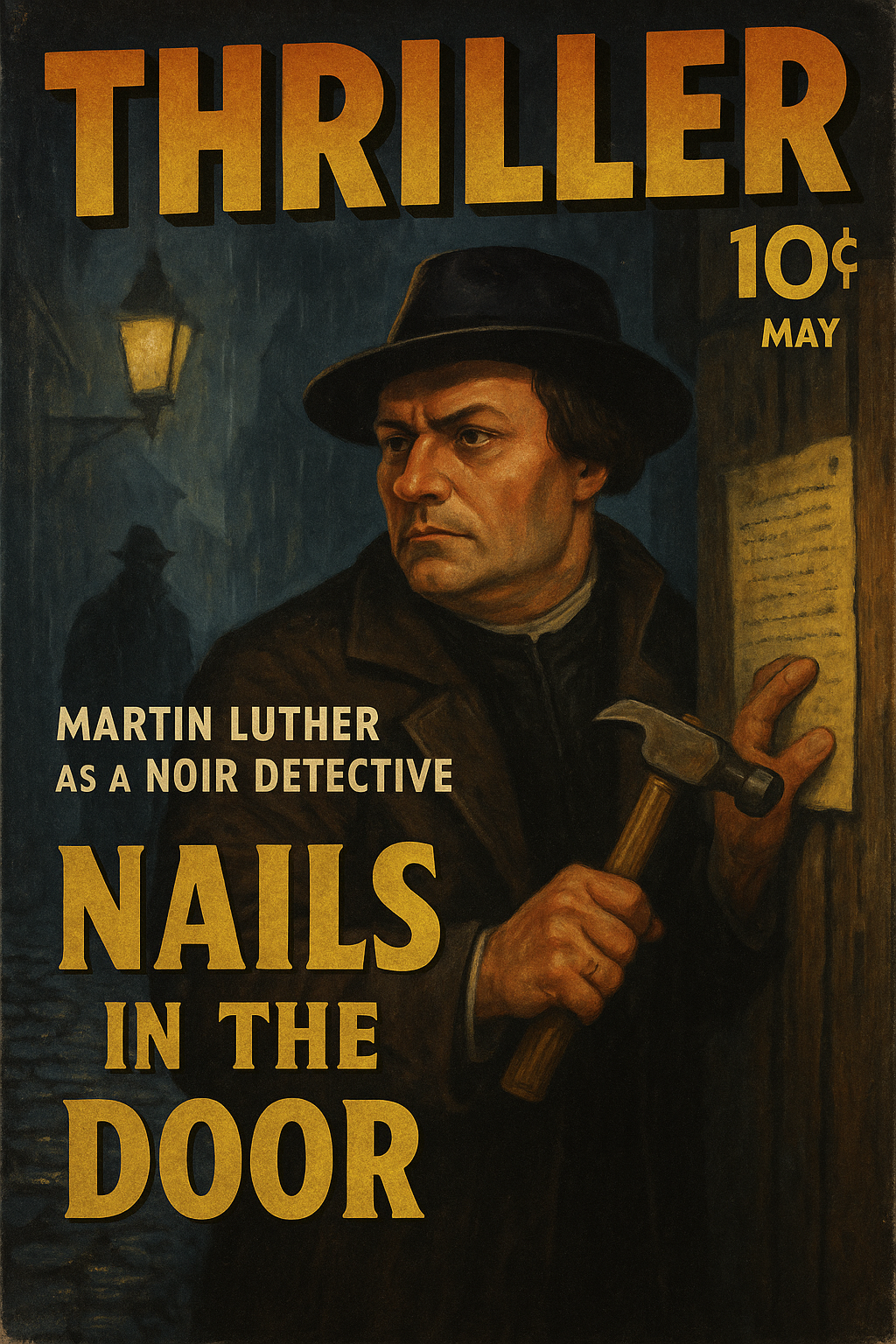
Luther pulled his cloak around his shoulders, took up the hammer. It felt good in his hand—solid in a world built on hot air and papal decrees. Under his other arm, the rolled parchment: ninety-five questions that might start a conversation… or a war.
The Castle Church loomed in the mist like a sleeping giant—Gothic stone, iron-bound doors. Here was where the university posted its disputes. By morning, relic-seekers would crowd the square, come to gawk at Prince Frederick’s five-thousand-piece collection of holy bones and splinters, all guaranteed to shave time off purgatory. Luther’s words would keep strange company.
The rain turned the square into a mirror. A few drunks stumbled between taverns. Somewhere a dog barked once and shut up. Luther walked toward the church like a man to the gallows—steady, deliberate.
The oak door was dark and scarred, iron hinges older than any man alive. Initials were carved near the bottom—students marking turf, lovers making promises they wouldn’t keep. Decades of nails had left it pitted and worn.
He unrolled the parchment against the wood. The Latin looked proper in the lamplight, each point numbered with a surgeon’s precision. But under the formality, the thing was dynamite—suggesting the Pope could be wrong, the Church corrupt, the indulgence trade a shell game played on the frightened.
He set the first nail and swung. The crack rang across the square like a shot. A student looked up from his drink; a pilgrim’s hand went to the purse where his indulgence letters lay.
The second nail. The third. Each blow echoed off stone, a rhythm that matched his pulse. Eyes watched from shadows, but no one came closer. On paper it was just university business, nothing out of the ordinary.
But most people knew better. Luther wasn’t just posting a debate notice. He was challenging an empire built on fear and funded by coin that rolled uphill to Rome. Every nail was a step away from safety and toward something with no name yet—something that felt like staring down a firing squad.
Rain streaked the parchment, but the ink held. The last nail bit home. The document hung straight, catching the lamplight through the mist. No crowd. No guards. Just the scrape of a chair inside the church, the faint smoke from a chimney.
By dawn, copies would run through the scholars’ network. Someone would put them into German, and the presses in Leipzig and Nuremberg would multiply them into thousands. His hammering would echo far beyond Wittenberg.
In the square, two merchants stood under a shop awning, indulgence papers in hand. The older man crumpled his, muttering a curse about Tetzel. The younger stared at the church door, calculating.
Luther walked back to his study, hammer cold now but still real. The nails were set, the challenge made. Whatever came next wouldn’t be easy to pull out.
Behind him, the parchment hung like a wanted poster—ninety-five questions that would have half of Europe asking if the Church was in the salvation business or just the money business. He pulled his cloak tight and disappeared into the dark, leaving the words to work in the German rain.
Like he had just nailed the colors to the mast.