
Reformation Week: Why Remaining Lutheran Is Remaining Catholic and Apostolic
A Call to the Faithful: Why the Confessional Lutheran Church Alone Keeps the Apostolic Faith

This week, the Church celebrates the Festival of the Reformation. For some, it’s treated like a Protestant holiday—a chance to wave a German flag, sing “A Mighty Fortress,” and move on. But the Reformation is not nostalgia. It is a confession: that the faith of the Augsburg Confession is the one, holy, catholic, and apostolic faith—because it clings to Christ alone, to the Word alone, to the grace of God given through His instituted means.
Reformation Day is not about breaking from the Church. It is about remaining in it.
1. The Church as Christ Founded Her
The Scriptures never describe the Church as a human organization or an invisible idea. The Church is where Christ Himself is present by His Word and Sacraments. St. Paul writes, “There is one body, and one Spirit… one Lord, one faith, one baptism, one God and Father of all” (Ephesians 4:4–6, ASV). That unity is not built by our choice or maintained by committees—it is the unity of Christ’s own body.
The early believers “continued steadfastly in the apostles’ teaching and fellowship, in the breaking of bread, and the prayers” (Acts 2:42, ASV). That pattern is not optional. It defines the Church’s heartbeat: Word, Sacrament, Prayer.
The Augsburg Confession captures this perfectly: “The Church is the congregation of saints in which the Gospel is rightly taught and the Sacraments are rightly administered” (AC VII). In other words, the true Church exists wherever the Word and Sacraments are at work creating faith and forgiving sin. This is not Lutheran innovation—it is apostolic reality.
2. The Catholicity of the Confession
The Lutheran Reformation never set out to build something new. It was the Church recalling herself to what she already was. St. Irenaeus of Lyons wrote around A.D. 180, “The Church, though scattered through the whole world, yet as if occupying but one house, carefully preserves [the faith] as if she possessed only one soul and one heart… she preaches, teaches, and hands it down with perfect harmony, as if she possessed only one mouth” (Against Heresies, I.10.2).
That’s catholicity—not a Roman bureaucracy, but the one voice of the faith once delivered to the saints. Vincent of Lérins would later summarize this as the rule of faith: “What has been believed everywhere, always, and by all” (Commonitorium, 2). The Lutheran Church confesses this very thing: that the ancient faith remains intact where the Gospel is pure and the Sacraments are administered according to Christ’s command. We have not redefined the Church; we have refused to leave it.
3. The Unity of the Church
Augsburg Confession VII continues: “To the true unity of the Church it is enough to agree concerning the doctrine of the Gospel and the administration of the Sacraments.” True unity isn’t found in external power, liturgical style, or historical lineage—it’s found in Christ’s doctrine and gifts.
The Smalcald Articles echo this: “Thank God, today a child seven years old knows what the Church is—namely, the holy believers and lambs who hear the voice of their Shepherd” (SA III, XII). The Lutheran Confessors were not inventing a new sect; they were pointing out what the Church has always been: believers gathered by the Gospel, fed by Christ Himself.
4. When Sheep Wander
The Reformation also forces us to face a painful question: what happens when people leave the Confession of Augsburg for “greener pastures”?
a) The Non-Denominational Drift
Many drift toward non-denominational movements claiming to be “just about Jesus.” But the Jesus they often preach is detached from His own means of grace. They speak much of faith but little of Baptism, much of love but little of the Supper, much of Scripture but without the Church’s confession to anchor it.
St. Paul warns, “Though we or an angel from heaven should preach unto you any gospel other than that which we preached unto you, let him be anathema” (Galatians 1:8, ASV). The Gospel is not improved by spontaneity; it is preserved by faithfulness. The apostles’ pattern—teaching, fellowship, breaking of bread, and prayers (Acts 2:42)—is not a menu of options. It is the very life of the Church.
b) The Papal Temptation
Others, weary of modern confusion, are seduced by Rome’s promise of visible certainty. But certainty does not come from the papal office; it comes from Christ’s Word and Sacraments. The Treatise on the Power and Primacy of the Pope says clearly: “The Gospel does not give the Pope more power than other bishops” (Treatise 11). Rome’s claim that the bishop of one city possesses divine supremacy over all others is not from Christ but from ambition. True catholic unity rests not in a throne, but in the pure Gospel.
c) The Eastern Allure
Some go East, drawn to its supposed beauty and mystery. Yet when the clarity of justification by faith alone is lost, beauty is lost. Like a whore who hides her shame behind cakes of makeup, so is the alluring facade of those who try to have beauty without grace. St. Paul’s teaching remains clear: “Being justified freely by His grace through the redemption that is in Christ Jesus” (Romans 3:24, ASV). The Church’s beauty is Christ’s righteousness, not our incense.
d) The Path of Unrepentance
And some simply leave because the Church refuses to bless their sin. Our Lord’s words cut through sentimentality: “If thy brother sin… tell it unto the church; and if he refuse to hear the church, let him be unto thee as the Gentile and the publican” (Matthew 18:15–17, ASV). St. John adds, “They went out from us, but they were not of us” (1 John 2:19, ASV). To leave Christ’s Church for impenitence is not liberation—it is exile. Church discipline is not cruelty; it is a final act of love meant to call the sinner home.
5. The Heart of a Shepherd
We do not speak these truths to boast but to plead. St. Cyprian said, “He cannot have God for his Father who has not the Church for his mother” (On the Unity of the Church, 6). That is why the Lutheran Church prays and labors for the return of the wandering. The Church is not a club of the perfect—it is the Mother who bears her children through the font, nourishes them at the altar, and disciplines them for their salvation.
Christ Himself gave the office of the Keys for this very purpose: “The Keys are an office and power given by Christ to the Church for binding and loosing sin” (SA III, VII). Forgiveness is not an idea floating in the air; it is spoken, heard, and received. That is catholic faith in practice.
6. Remaining Lutheran Is Remaining Catholic
To remain Lutheran is not to remain in a cultural identity; it is to remain where Christ’s voice still sounds, where His Body and Blood are given for the forgiveness of sins, where the apostolic faith is still confessed without compromise.
The Reformation was not rebellion—it was repentance. It was the Church being recalled to herself, purged of abuses that buried the Gospel. To be Lutheran is to be part of that one, holy, catholic, and apostolic Church which Christ Himself promised to preserve until the end (Matthew 28:20).
St. Irenaeus saw the same reality: “Where the Church is, there is the Spirit of God; and where the Spirit of God is, there is the Church” (Against Heresies, III.24.1). The Holy Spirit gathers not around papal decrees or private enthusiasm, but around the preached Word and the holy Sacraments. That is where Christ’s Church stands—and where His people remain.
6. A Hymn for the Love of the Church
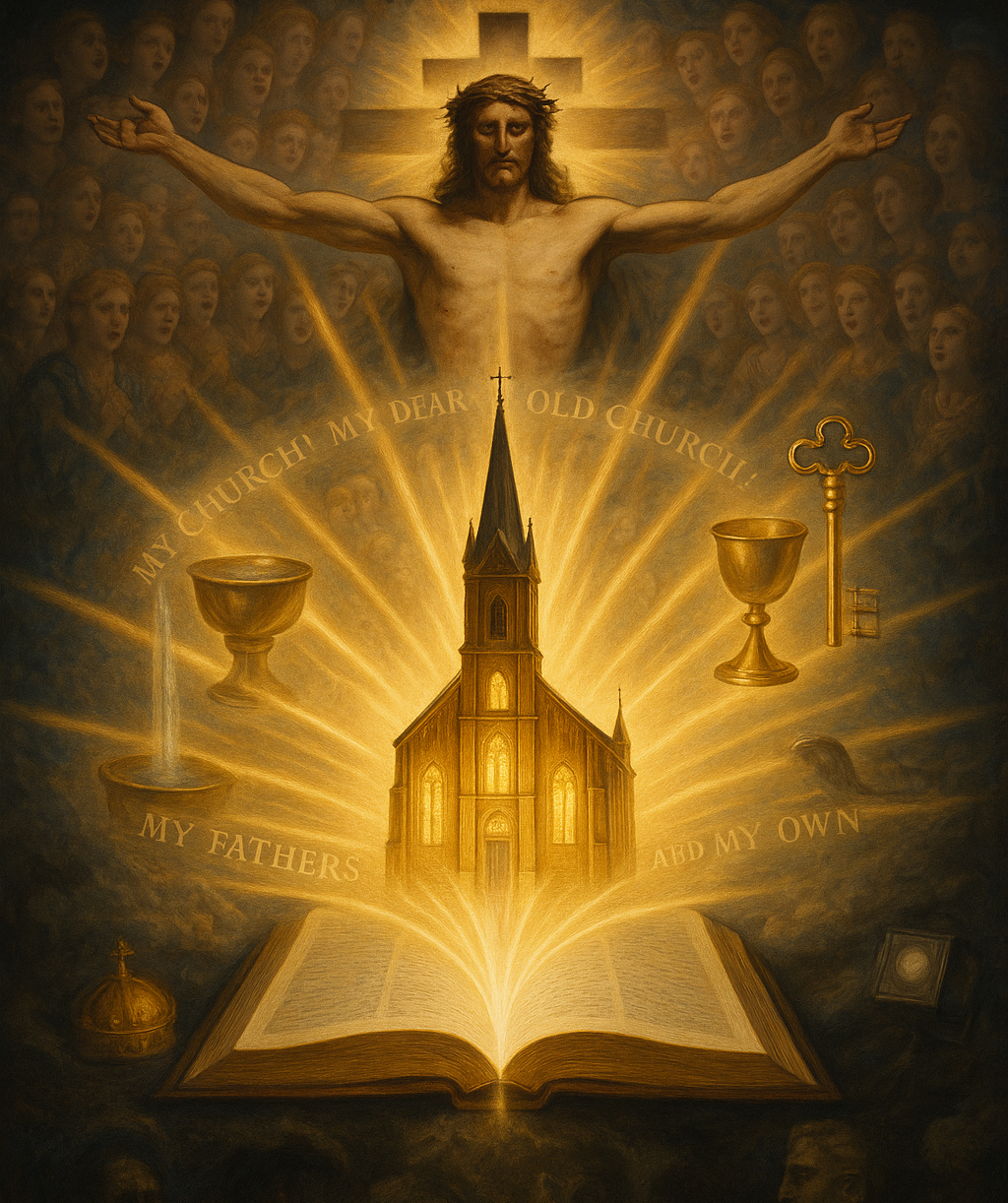
The truths confessed on Reformation Day have often found their echo not only in sermons and confessions, but also in song. One such hymn is “My Church! My Church! My Dear Old Church!”
Its verses affirm precisely what the Augsburg Confession declares—that the true Church endures not by novelty or power, but by the pure Word of God and the Sacraments administered as Christ ordained. In every stanza, the singer takes up the voice of a faithful child of the Reformation, rejoicing in the one holy, catholic, and apostolic Church which cannot be overthrown. It is, in many ways, a sung summary of the Reformation itself—an unashamed, grateful confession: “But not my Church, my dear old Church, my fathers’ and my own.”
My Church! my Church! my dear old Church!
My fathers’ and my own!
On prophets and apostles built,
And Christ the corner-stone!
All else beside, by storm or tide,
May yet be overthrown;
But not my Church, my dear old Church,
My fathers’ and my own!
My Church! my Church! my dear old Church!
My glory and my pride!
Firm in the faith Immanuel taught,
She holds no faith beside.
Upon this rock, ‘gainst every shock,
Though gates of hell assail,
She stands secure, with promise sure—
“They never shall prevail.”
My Church! my Church! I love my Church,
For she doth lead me on
To Zion’s palace beautiful,
Where Christ my Lord hath gone.
From all below she bids me go
To Him, the Life, the Way,
The Truth to guide my erring feet
From darkness into day.
My Church! my Church! I love my Church,
For she exalts my Lord!
She speaks, she breathes, she teaches not,
But from His written Word.
And if her voice bids me rejoice,
From all my sins released,
’Tis through the atoning sacrifice,
And Jesus is the Priest.
Then here, my Church! my dear old Church,
Thy child would add a vow,
To that whose token once was signed
Upon his infant brow:–
Assault who may, kiss and betray,
Dishonor and disown,
My Church shall yet be dear to me,
My fathers’ and my own!