
Technological Terror of the Human Mind: An Essay on Fear of Repetition and Waste (Pt. 2 of 2)
The mind loops like a broken reel on consequences of a crime uncomitted.

I set myself up for failure with the previous post on repetition. I do love rhythm and repetition, that is not going to change. But mind-numbing continuance of tired repetitions is something I truly fear. Such is the case with the arguments either for or against the use of AI in writing.
It's like watching a tennis match where both players keep hitting the same shot over and over until you're ready to throw your overpriced stadium hot dog at them. Trust me, as someone who's spent years crafting sermons, songs, and podcast episodes, I recognize the difference between artful repetition that creates resonance and the kind that makes listeners check if their audio is glitching.
The AI writing debate has become exactly that kind of broken record. One side clutches their pearls about the death of human creativity while the other promises a utopia where we'll all be freed from the tyranny of typing. Meanwhile, I'm sitting in my study in Chipley, surrounded by theological texts and half-finished song lyrics, wondering if either extreme has bothered to consider the nuanced middle where most of us actually live and create.
When I'm working on lyrics for my next folk-Americana track or preparing material for "The Bookcase Behind Me" podcast, I'm not thinking about whether AI is good or evil—I'm thinking about what serves the message. What honors the craft. Sometimes that means embracing new tools; other times it means putting them aside.
The fear isn't really about AI—it's about losing our connection to the soul of creativity, that mysterious space where loss and joy and faith all converge. After my bandmate passed in 2013, I didn't return to songwriting because I had better tools—I returned because I had something that needed expression, something no algorithm could have extracted from my grief.
Still, I am not opposed to new technologies and tools. I was vehemently against drum sampling on songs until I found out that the producer of Megadeth's "Peace Sells... But Who's Buying" album utilized drum samples. Not as a replacement for the drummer's performance or a cheap way to cover up bad recording techniques, but as a way to get a fuller sound and make the beat hit even harder. That revelation was like finding out your straight-edge pastor secretly enjoys a good bourbon—shocking at first, then oddly reassuring in its humanity. I think I may be coming around to this use of AI in creative works, such as my drawing and writing, as well.
I will admit that I'm not fully on board yet, but I see how it can be useful for organizing my writing and helpful in the editing process. It's like having an eager intern who never sleeps and doesn't mind when I change my mind seventeen times about chapter structure at 2 AM. I have even started to experiment with AI enhancements to my sketches to make my own book covers for those pulp fiction novels I've been working on. The kind that would make Raymond Chandler raise an eyebrow and maybe pour himself another drink. This type of experimentation seems so benign and banal that it wouldn't be controversial. It isn't like I'm replacing my writing, my music, or my rhythm with artificial prompt, right? I'm still the one wrestling with theological concepts for the podcast and sweating over chord progressions in my basement studio.
Well, if you listen to any of the radical anti-AI creatives, then you would consider my lackluster experimentation with AI to be absolute heresy to the creative process, complete with lynch mobs ready to burn me at the stake with the accusation that they have found a witch and must burn her. These folks act like I've suggested replacing the Holy Trinity with a silicon chip. Their faces turn the same shade of crimson I see when someone suggests that rockabilly isn't "real music" during our parish potlucks.
This goes right into the fear of repetition I wrote about last week. Before I even thought about experimenting with AI as a tool, I decided to run a few tests. Not unlike when I test sermon material on my wife before delivering it to the congregation at St. Patrick—if she falls asleep or checks her phone, I know I need to punch it up a bit. So I approached AI with the same cautious curiosity I bring to new theological texts...
I dived into the literature, I read blogs, I listened to both sides of the argument. I watched AI-bro YouTube videos with their perfectly lit home offices and suspiciously white teeth telling me how I could "10x my productivity." I suffered through creatives who were so uncharitable towards the other side they made denominational disputes at pastoral conferences look downright cordial. And I spent hours with people in the middle who use AI but don't let it control their every thought—the digital equivalent of social drinkers. After weeks of this intellectual binge-watching, bleary-eyed and caffeine-addled, I came across AI detection tools and the studies that have been done on them.
I was in complete dismay when I ran a short story I wrote in 2016—long before ChatGPT was even a twinkle in OpenAI's corporate eye—and it came out 77% AI generated. This was like being told my firstborn son was actually fathered by the mailman. I was, needless to say, confused. And slightly offended. Did my natural writing style somehow predict future robot prose? I ran it through a few more detection tools and the numbers were everywhere. 67%, 27%, 7%. Does the AI detector just like numbers ending in seven? Is this some bizarre numerological conspiracy? I tried several other writings with the same mixed results—my sermon on Galatians registered as more artificial than my rockabilly lyrics. Entire passages of the Bible came out as AI generated. Even Moby Dick is AI generated!
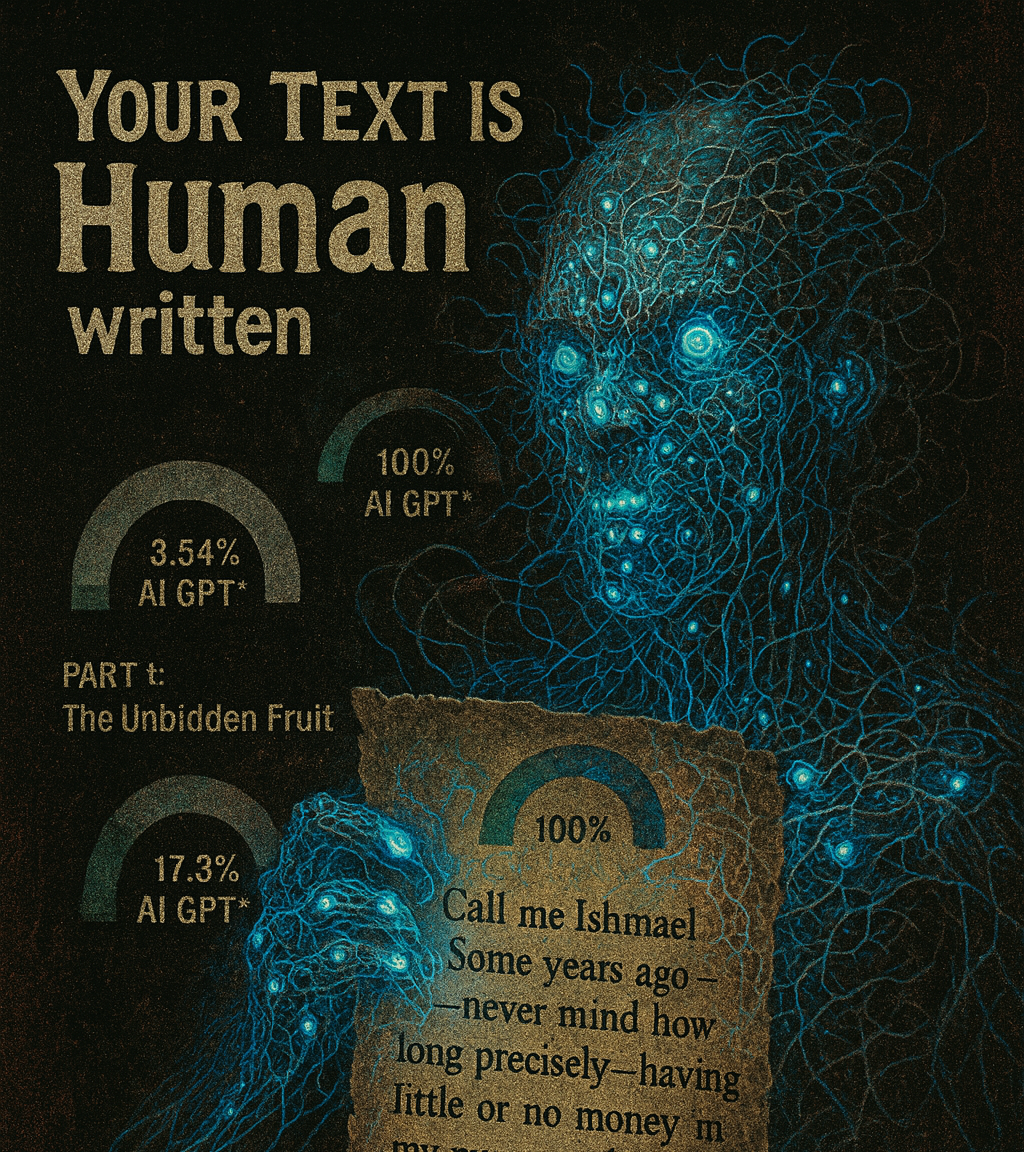
It wasn't until I found a study from Cornell that I figured out what was going on... the detection tools are just picking up on patterns and repitition. Nothing more and nothing less.
Long story short, AI detection tools are a massive scam, the snake oil salesmen of the digital age. They can only pick up on patterns and repetitions that are likely to be present in AI generative texts—about as scientific as my grandmother's method of predicting rain with her arthritic knee. The study from Cornell actually concluded with this observation...
"This paper exposes serious limitations of the state-of-the-art AI-generated text detection tools and their unsuitability for use as evidence of academic misconduct. Our findings do not confirm the claims presented by the systems. They too often present false positives and false negatives. Moreover, it is too easy to game the systems by using paraphrasing tools or machine translation. Therefore, our conclusion is that the systems we tested should not be used in academic settings…. Our findings strongly suggest that the “easy solution” for detection of AI-generated text does not (and maybe even could not) exist." (vhttps://arxiv.org/pdf/2306.15666)
That is a relief! I wasn't just a fleshy robot… I am just predictable!
Finding out this information gave me a decent reason to start experimenting with AI tools. I wasn't cowering in fear anymore like a toddler who'd just discovered the monster under the bed was actually the family cat. I still firmly believe AI shouldn't replace anything in my writing—that would be like hiring someone else to kiss your spouse—but the existential dread had subsided considerably.
I'm especially unimpressed with the modern-day soothsayers who strut around claiming they can "spot AI writing instantly" with their supposedly supernatural perception. These digital witch doctors peddle their snake oil to anxious writers while the very AI detection tools that suckers are forking over $20 a month for have been absolutely obliterated, stomped into cosmic dust by rigorous scientific investigation. It's like watching someone confidently read tea leaves while standing in the middle of a hurricane—impressive confidence, spectacularly misplaced.
I was even more relieved that I didn't have to be afraid of my own proclivities—my own philosophy. Well known, often lamented—often mourned, facts of penal lore. (If you get that reference, we just became best friends.) I could embrace repition without wasting it. I could experiment with a new tool without feeling like I was loosing my own voice.
All this comes back to waste. I fear wasting my time with this and not being able to do what I love to do. It's that gnawing worry that I'm distracting myself from the real work. I will likely explore AI as a topic in future Monday Musing posts, diving into its implications for creativity and the human experience, but now I just want to embrace the rhythm of writing and not let any of it go to waste—the cadence, the flow, the strange little detours my brain takes when left to its own devices.
I am a fraud because I write the way I do and people will always assume the worst. My repetitions, my sentence fragments, my occasional descent into folksy metaphors—all potential evidence for the AI prosecution. Some reader somewhere is squinting at my prose right now, thinking, "Hmm, that's suspiciously polished," not knowing I agonized over that paragraph for forty-five minutes while smoking some Autumn Evening tobacco. But I can rest knowing that what makes me the writer that I am is not the product of a fine-tuned algorithmic computer—it's the messy, contradictory, occasionally brilliant, often stumbling product of three-ish decades of living, reading, making music, preaching, and trying to make sense of this bizarre world we inhabit.
It is the technological terror of the human mind.
And I am okay with that for now.