
Technological Terror of the Human Mind: An Essay on Fear of Repetition and Waste (Pt. 1 of 2)
The mind loops like a broken reel, haunted by the ghost of wasted motion.

Rhythm. The pace. The feel. The heartbeat. I adore rhythm. The first instrument I ever had any formal lessons on was the drums. I was a cymbal monkey in middle school and on the drumline in high school. I played drums for multiple hardcore punk bands throughout my life. Despite the noise, I took to it like a fish to water. All because of the rhythm. Rhythm is everything to me. I simply cannot put into words how beautiful and awe-inspiring it is to hear a great Rhythm, even more so to play it for yourself.
I was diagnosed with Asperger's syndrome when I was five years old. (I know we are supposed to call it Autism Spectrum these days, but I am no expert, so you get the full unpolished version here.) Ever since I could remember, I have had my patterns, my routines, my rhythm. I can adapt to change, but it is never easy. I need rhythm.
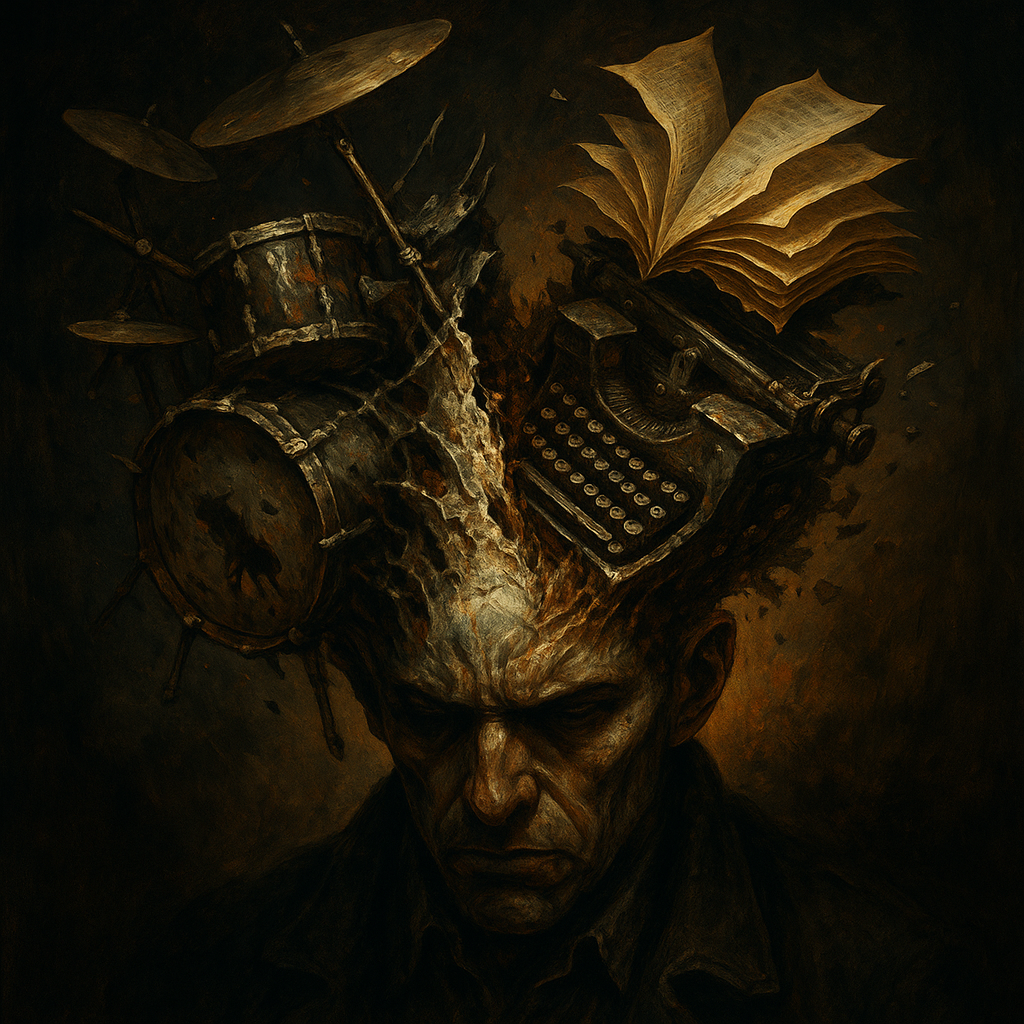
My writing has rhythm. You may be able to spot it in this little post. Lord willing, when my novella's hit the market, you will likely be able to highlight excessive patterns in my work that make it uniquely my own. It can be sometimes generic and often repetitive, but there is something about the feeling of hammering home the point. It has rhythm.
If the repetitive nature of my writing were to be shallow, it would quickly become monotonous and dull, like the droning hum of a poorly tuned engine. But if the rhythm is skillful and moves with some amount of grace and finesse, if it's wild and unencumbered, then you have something special in the pattern. You have a rhythm that isn't just a mechanical beat but a living pulse, a heartbeat that resonates with the reader. It's the difference between tapping your foot to a lone metronome and dancing to a vibrant, unpredictable melody. The rhythm should guide you, surprise you, make you feel something deep within your bones. That's when repetition becomes not just tolerable but enjoyable, even necessary. It's the rhythm that turns mere words into a symphony, a rhythm that makes the story come alive and gives it a heartbeat of its own.
Of course, a metronome is essential. I can already hear the protests from all the so-called drummers out there but trust me on this one. Yes, you absolutely need to practice with a metronome, and you should even perform with one if it helps. The structure and discipline it provides are key to separating the novices from the experts.
Think of it this way: let's say you only have one drum beat in your repertoire. Just that single, lonely beat. But, if you take that beat and you practice it relentlessly with a metronome, gradually refining and perfecting it, you will be lightyears ahead of the game. You'll be miles ahead of all those wannabe drummers out there, even the flashy ones who think they can impress with their intricate beats. It's not about complexity; it's about precision and groove.
You see, anyone can make noise and throw in a bunch of fancy fills and flourishes. But it takes real skill to take a simple beat and make it swing. To make it groove so hard that people can't help but move their feet and feel the music in their souls. That's the beauty of rhythm and the power of the metronome. It's like a sculptor's chisel, helping you chip away the unnecessary bits and revealing the true shape of the music.
So, to all the drummers out there, I say embrace the metronome as your friend and teacher. Let it guide you in finding the heartbeat of the music. And to the writers, poets, and creators of all kinds, remember that sometimes structure and repetition, when used skillfully, can create a rhythm that captures the essence of your unique voice. It's all about finding that sweet spot where your creation comes alive, taking on a life of its own.
Now, with all that being said, you might think I'd be the first to champion the cause of rhythm in all its forms, a veritable metronome messiah. But, imagine my utter shock and horror when I slowly discovered—or rather, when it was thrust upon me by countless individuals, from all corners and in the most unvarnished of tones—that the very thing I loved, the rhythm that I breathed like air in both music and writing, was the exact thing that was making me a fraud. Not just any fraud, mind you, but the biggest fraud to ever pick up a pen or a pair of drumsticks.
It started with a whisper, a slight comment here and there. "Brandon, your rhythm is a bit... predictable." "Isn't there a bit too much structure in your writing?" I'd brush it off, chuckle even. After all, these were the same people who couldn't tell a syncopated beat from a syncopated heart attack. But then the whispers grew louder, more insistent. "Your music is too formulaic." "Your prose lacks spontaneity." It was as if I'd been happily dancing a jig, only to be told that my shoes were nailed to the floor. The very thing I thought was my strength, my unique voice, was suddenly being touted as my greatest weakness. It was like being told that my heartbeat was too steady, that my pulse was too reliable. And the worst part? I couldn't help but start to agree with them.
Here’s the thing about rhythm and repetition—they’re everywhere. The Bible doesn’t hesitate to roll out its steady beat of “and it came to pass” or the long lines of “begats” marching through the generations like a literary drumline. The language and themes repeat in a cycle of fall, redemption, and resurrection. Pulp heroes crack the case, kiss the girl, and toss off a one-liner like clockwork. Even Shakespeare leaned on iambic pentameter—and no one’s calling the Bard predictable, at least not to his face.
The stories that really stick with us often do so because they tap into some deep expectation we didn’t even know we had. They’re like comfort food—we might know the destination, but we still savor the ride. The hero’s journey isn’t timeless because it’s groundbreaking. It’s timeless because it speaks to something buried deep in the human soul. It’s the heartbeat under everything.
So maybe my rhythm isn’t a crutch—it’s a signature. Maybe the structure in my writing isn’t playing it safe but laying a foundation strong enough to hold whatever wild, messy, beautiful thing I decide to build on top. Maybe predictability, when handled right, isn’t the death of creativity but its oldest and most loyal friend.
And yet... I can’t help but wonder if I’ve gotten a little too comfortable in my own groove…. comfortable enough to be mistaken for a robot with human flesh…
To be continued…
Next Week: Technological Terror of the Human Mind, Pt. 2