
The Case for Pulp: Why Those Tattered Magazines Hold the Key to Bold Christian Storytelling
Moral clarity. Grit. Wonder. And a message that still speaks to the common man.

I've been wrestling with this idea for years now—both behind the pulpit and hunched over my writing desk. Every time I sit down to craft a sermon, write a song, or work on my fiction, I keep circling back to those dog-eared pulp magazines collecting dust in secondhand shops. You know the ones I'm talking about: lurid covers, breathless prose, heroes with square jaws and even squarer morals.
The stories your grandparents hid under their mattresses but couldn't stop reading. The ones modern literary types dismiss with an eye-roll. "Genre fiction," they sniff, like it just tracked mud across their Persian rug.
But here's what I've discovered during countless late nights at my keyboard, coffee growing cold: those 1930s pulp stories might be exactly what Christian storytelling needs right now. And I've got five reasons why—reasons that also explain why today's "serious" fiction seems allergic to everything that makes pulp so powerful.
Just like an old rockabilly tune, sometimes you need to look backward to move forward.
1. Good vs. Evil Takes Center Stage
Pulp doesn't apologize for clear moral lines. Heroes fight monsters, corruption, cosmic darkness. Perfect territory for showing Christ as Light piercing the void.
When I crack open one of those 1930s magazines, the moral landscape spreads out like Florida's horizon—clean, direct, unambiguous. The Shadow knows exactly who deserves justice. Doc Savage never second-guesses whether the mad scientist has a point. The Spider doesn't form a committee to debate the ethics of stopping crime lords.
And honestly? That's refreshing. In our current moment where suggesting objective moral truth labels you an intellectual dinosaur, these stories feel like cold water in the desert. The heroes stand for something. They have moral codes that don't bend with cultural winds. They recognize evil and oppose it without apology.
This is why pulp provides such fertile soil for Christian storytelling. Jesus didn't equivocate about good and evil. He called the Pharisees "vipers" without issuing trigger warnings. He spoke of sheep and goats, wheat and tares, light and darkness. The Bible presents a cosmos where moral choices carry eternal weight—just like pulp universes where choosing wrong means real peril.
Modern readers, despite their supposed sophistication, still hunger for stories where right and wrong exist as more than social constructs. They want heroes worth cheering for, villains worth booing, and a sense that the universe isn't morally neutral. Pulp gives us permission to write stories where the battle between good and evil matters—because it does.
2. It's Gritty, Not Sanitized
Pulp tackles real human depravity—violence, lust, greed—without glamorizing it. Perfect territory for showing Law's full force… and Gospel breaking in like sunrise.
Most Christian fiction either sanitizes everything to absurdity or wallows in darkness without redemption. Pulp hits the sweet spot—acknowledging sin's sewage while pointing to grace's cleansing waters. The detective walks through the red-light district but doesn't celebrate it. He sees it for what it is.
When workshopping a scene where my protagonist gets brutally beaten for her faith's moral clarity, a fellow writer suggested I tone it down to make it more "appropriate." I nearly laughed. Have they read the Bible lately? David's adultery and murder plot? The horrific violence in Judges? Scripture doesn't sanitize human sin—it exposes its ugliness precisely to highlight our desperate need for redemption.
That's what I love about pulp. The Phantom Detective might encounter opium dens and human trafficking, but the story never winks at these evils or presents them as "alternative lifestyles." There's moral clarity that feels almost rebellious in our relativistic age. The hero recognizes evil, names it, and stands against it. Yet unlike some Christian fiction with cardboard villains twirling metaphorical mustaches, pulp villains are believably, recognizably human in their brokenness. They're not monsters—they're people who've surrendered to their worst impulses, making their evil more chilling and the hero's resistance more necessary.
3. Action Reveals Character
In pulp, what you do matters. That's deeply biblical. Think James 2:18—"I by my works will show thee my faith." Character arcs aren't just talk; they're tested in fire.
When The Shadow faces a criminal mastermind, his choices reveal who he truly is. When Peter steps from the boat, his actions reveal both faith and doubt. I've discovered that putting characters in life-or-death situations strips away pretense and reveals the soul beneath—something Jesus did repeatedly.
I remember wrestling with a scene where my protagonist had to choose between self-preservation and sacrifice. For three days I stared at a blinking cursor, struggling with what felt true to the character. Would he run? Would he stay? The moment demanded more than clever dialogue—it demanded defining action.
This translates between my fiction and pastoral work. When counseling someone struggling with addiction or marriage problems, I'm less interested in what they say they believe than in what their daily choices reveal about priorities. Talk is cheap in pulp fiction and in life. The rich young ruler had all the right theological answers until Jesus challenged him to act by selling his possessions—suddenly his true character was laid bare.
4. It Embraces Wonder and Dread
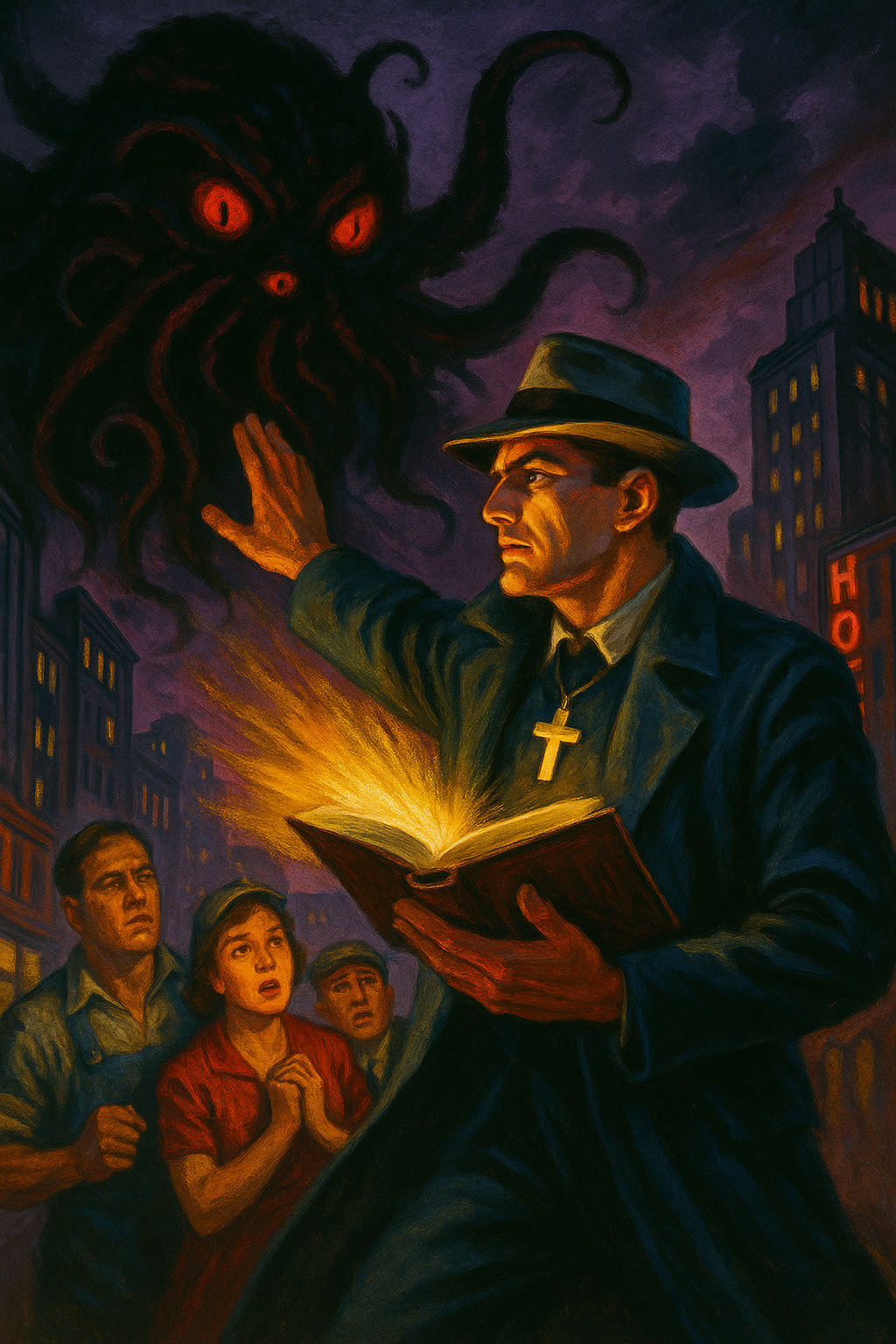
From Lovecraftian horror to sword and sorcery, pulp taps into awe. Christianity owns awe. Angels with six wings. A God who dies and rises. A world where sin is real and grace is cosmic.
I've spent hours flipping through old pulp magazines, marveling at their covers—tentacled monstrosities, brave heroes facing impossible odds, mysterious phenomena defying explanation. Then I'd open my Bible for sermon prep and find the same wonder and terror. Daniel describing beasts rising from the sea with iron teeth. John's vision of a seven-headed dragon sweeping stars from heaven. Moses encountering a bush that burns but isn't consumed.
This is where pulp fiction and sacred text overlap—they both understand that reality is stranger and more wonderful than our mundane experience suggests. When writing fiction, I'm constantly drawn to moments where characters confront something larger than themselves, something inspiring both dread and fascination.
The modern church has often sanitized Scripture's wild elements, turning the untamed God of the Bible into something safe and domesticated. We've lost that holy fear pulp writers intuitively understood. When the angel appears to Mary, his first words are "Fear not"—which only makes sense if encountering an angel naturally terrifies. Our faith should occasionally leave us slack-jawed and trembling, confronted with barely comprehensible glory.
5. It Speaks to the Common Man
Pulp was written for everyday people. Short. Punchy. Relatable. Not academic. Christ came for fishermen and tax collectors, not just scholars.
When writing songs or sermons, I've learned the hard way that big words and complex syntax don't make me sound smarter. Jesus knew this—that's why he spoke in parables about lost coins and prodigal sons.
Pulp writers understood this instinctively. They didn't write to impress literary critics or secure academic tenure. They wrote for factory workers on lunch breaks, housewives stealing moments between chores, everyday people seeking escape and meaning. Their prose had to grab you by the collar—no patience for pretension or unnecessary complexity.
Why Modern Fiction Fears the Pulp
Today's fiction avoids pulp's style because it fears being "too sincere," "too moral," or "too uncool." It hides behind irony, detachment, and moral ambiguity—as if passion and conviction are embarrassing relics of a simpler time.
I've seen this at literary meet-ups where authors pride themselves on protagonists so morally gray they're practically translucent. There's an unspoken rule that if your character has clear convictions or—heaven forbid—a moral compass, you've created something quaint and unsophisticated.
We've become so afraid of appearing judgmental or preachy that we've neutered our stories of their power. I remember reading a contemporary novel where the author spent three pages describing a sunset but couldn't have a character declare anything with certainty beyond their coffee preference.
Meanwhile, stories that have endured for centuries—the ones still grabbing us by the throat—don't shy away from moral clarity. The Bible doesn't hedge with "perhaps sin is problematic in certain contexts." It declares. It proclaims. It says things matter with chest-thumping certainty.
Christianity thrives in stories where good matters, evil is real, and stakes are eternal. The gospel isn't cool or detached—it's life and death, heaven and hell.
Revive pulp. Preach Christ. Write bold.
Which pulp genre calls to you? Noir? Horror? Adventure? I've dipped my toes in several waters already, and there's nothing quite like crafting a tale where shadows are deep but light breaks through anyway.
What's your take? Are you ready to embrace the power of pulp in your own storytelling? Drop me a line—I'd love to hear about your adventures in bold, unashamed fiction.