
The Forgotten Doctrine of Authority in a Postmodern World
Authority isn’t oppression—it’s God’s gift.

Introduction
The postmodern world has not merely grown suspicious of authority; it has grown allergic to it. In our age, “authority” ranks somewhere between a gluten allergy and an IRS audit—something to be avoided at all costs. To speak of authority today is to invite accusations of tyranny, oppression, and arrogance. You can practically hear the slogans already: “Smash the patriarchy!” “Dismantle the hierarchy!” “No gods, no masters!”
Today’s ideologies insist that every order of creation is really just a power game. Parents? Oppressors. Pastors? Gatekeepers. Governments? Tyrants. Even biology is up for grabs—because who’s to say that chromosomes have more authority than your feelings? In this strange upside-down world, truth is “your truth,” authority is oppression, and rebellion is marketed as liberation (preferably with a rainbow logo during Pride month).
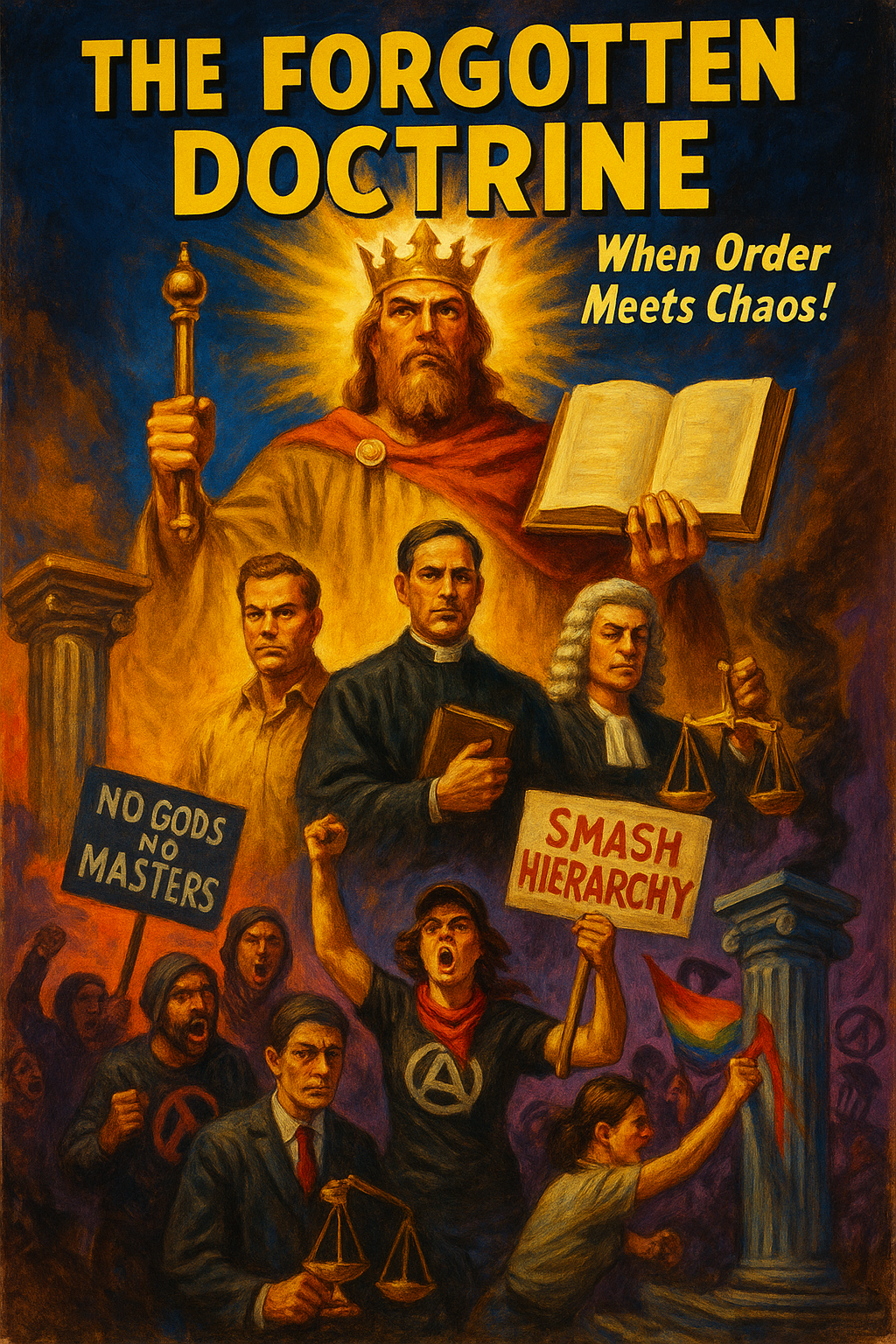
And yet, Holy Scripture, the Fathers of the Church, and our own Lutheran Confessions testify with one voice that authority is not a human invention but a divine ordinance. Authority belongs first to God, who rules all things by His Word, and then to those whom He has called and placed in offices of service for the good of His people. To despise authority is not edgy—it’s unbelief. To honor it is not blind obedience—it’s faith in the God who orders creation for our good.
In this essay, we will explore the forgotten doctrine of authority: what it is, why it matters, how it has been despised in our age, and how the faithful must learn to honor it again for the sake of Christ’s kingdom.
Authority Rooted in God Himself
Authority, rightly understood, begins with God. As the Psalmist declares:
“Jehovah hath established his throne in the heavens; And his kingdom ruleth over all.”
— Psalm 103:19 (ASV)
God is not merely the highest authority; He is Authority itself, for His will and His Word define what is true, good, and holy. The prophet Isaiah reminds us:
“Woe unto him that striveth with his Maker! a potsherd among the potsherds of the earth! Shall the clay say to him that fashioneth it, What makest thou?”
— Isaiah 45:9 (ASV)
To rebel against authority, then, is first and foremost to rebel against God.
St. Augustine writes:
“These things being so, we do not attribute the power of giving kingdoms and empires to any save to the true God, who gives happiness in the kingdom of heaven to the pious alone, but gives kingly power on earth both to the pious and the impious, as it may please Him, whose good pleasure is always just.”
— City of God, Book V Ch .21
The Three Estates and the Order of Authority
Martin Luther and the Lutheran Confessions speak often of the “three estates” or “orders” of life: the Church, the Household, and the State. These are not arbitrary human constructs but divine institutions through which God exercises His authority for the good of creation.
The Large Catechism explains:
“For all authority flows and is propagated from the authority of parents. For where a father is unable alone to educate his child, he employs a schoolmaster to instruct him; if he be too weak, he gets the assistance of his friends and neighbors; if he departs this life, he delegates and confers his authority and government upon others who are appointed for the purpose.”
— Large Catechism I.141
The Apostle Paul echoes this when he exhorts children to obey their parents, not as a mere social convenience but “in the Lord”:
“Children, obey your parents in the Lord: for this is right.”
— Ephesians 6:1 (ASV)
The Fourth Commandment, “Honor thy father and thy mother,” becomes the fountainhead of all temporal authority.
Authority in the Church
The world has grown suspicious of spiritual authority above all. The very word “pastor” is often caricatured as “power.” Yet the Lutheran Confessions are clear: the authority of the Church is not human dominion but the ministry of the Word.
The Augsburg Confession states:
“According to the Gospel, the power of keys or the power of the bishops is a power or command of God to preach the Gospel, to remit and retain sins, and to administer sacraments.”
— Augsburg Confession XXVIII.5
Christ’s words remain binding:
“He that heareth you heareth me; and he that rejecteth you rejecteth me; and he that rejecteth me rejecteth him that sent me.”
— Luke 10:16 (ASV)
This is not tyranny, but the gracious authority of Christ Himself exercised through the ministry. When the pastor forgives sins, it is as valid and certain as if Christ dealt with us Himself:
“Whose soever sins ye forgive, they are forgiven unto them; whose soever sins ye retain, they are retained.”
— John 20:23 (ASV)
St. Ignatius of Antioch, writing in the early second century, warned:
“Let no man do anything connected with the Church without the bishop. Let that be deemed a proper Eucharist, which is [administered] either by the bishop, or by one to whom he has entrusted it.”
— Ignatius, Epistle to the Smyrnaeans 8
Authority in the Church is thus sacramental, not political; spiritual, not coercive.
Authority in the Household
The collapse of authority in the modern West has begun in the home. Fathers are absent, mothers overburdened, and children unruly. Yet the home is the primal estate, instituted already in Eden.
The Apostle Paul declares:
“Wives, be in subjection unto your own husbands, as unto the Lord. For the husband is the head of the wife, as Christ also is the head of the church, being himself the saviour of the body. Husbands, love your wives, even as Christ also loved the church, and gave himself up for it.”
— Ephesians 5:22–23, 25 (ASV)
St. John Chrysostom preached on this very passage:
“Wives, be subject to your own husbands, as to the Lord. For the husband is the head of the wife, as Christ also is of the Church. And you husbands, do the things which pertain to love. Seek her profit. Reverence her. Be not bitter against her.”
— Chrysostom, Homily on Ephesians 20
Authority in the household is therefore cruciform—shaped by the self-giving love of Christ. Fathers rule by sacrifice, not by tyranny; mothers nurture in obedience to God; children learn honor and respect, which carries over into all of life.
Authority in the State
No less despised is civil authority. The modern cry is “No king but the self.” Yet St. Paul speaks with divine clarity:
“Let every soul be in subjection to the higher powers: for there is no power but of God; and the powers that be are ordained of God. Therefore he that resisteth the power, withstandeth the ordinance of God: and they that withstand shall receive to themselves judgment.”
— Romans 13:1–2 (ASV)
The Apology of the Augsburg Confession insists:
“The Gospel does not destroy the State or the family but especially requires that they be preserved as ordinances of God, and that charity be practiced in such ordinances.”
— Apology XVI.1
St. Clement of Rome, writing at the close of the first century, prayed for rulers:
“Thou, Lord, didst give the authority of the kingdom to them through Thy excellent and inexpressible might, that we, knowing the glory and honor which Thou hast given them, may be subject to them, in nothing resisting Thy will. Give to them, Lord, health, peace, concord, stability.”
— 1 Clement 61:1
The state, then, when it is in obedience, is God’s left-hand kingdom, in which He restrains evil and promotes external peace. To despise the Godly state is to despise God’s ordinance. Yet, when the state persecutes Chrsitians or gives itself over to perverse sin, we are told to obey God rather than men. (Acts 5:29)
The Postmodern Revolt Against Authority
Why, then, has authority been so thoroughly despised in our time? Postmodernism teaches that all authority is a mask for power, all truth a construct of the strong. The biblical order of authority—church, home, and state—is seen not as divine gift but as oppression to be deconstructed.
The result is chaos: churches without discipline, homes without fathers, states without respect to the rights of its citizens. The world reels under the burden of its own rebellion.
Yet Luther warned:
“For in the sight of God faith is what really renders a person holy, and alone serves Him, but the works are for the service of man.
— Large Catechism I.147
The rejection of authority is, put simply, unbelief. It is the serpent’s whisper:
“Ye shall be as gods.”
— Genesis 3:5 (ASV)
Christ: The Fulfillment and Judge of All Authority
All authority finds its meaning in Christ, who is both Lord and Servant. He declared:
“All authority hath been given unto me in heaven and on earth.”
— Matthew 28:18 (ASV)
Yet He also said:
“For the Son of man also came not to be ministered unto, but to minister, and to give his life a ransom for many.”
— Mark 10:45 (ASV)
In Christ, authority is not domination but service, not oppression but sacrifice. He rules by giving His life, and in His resurrection He is exalted as King of kings and Lord of lords.
St. Irenaeus wrote:
“For inasmuch as the Word was made flesh, He summed up in Himself all things… both the visible and the invisible, so that He Himself might be the Head of all things.”
— Irenaeus, Against Heresies V.20.2
Therefore, to honor authority is to honor Christ; to rebel against authority is to rebel against Christ.
Recovering the Forgotten Doctrine
What, then, must the Church do?
- Preach the Fourth Commandment boldly. Authority is not optional but divine ordinance.
- Recover catechesis in the estates. Teach children, families, and congregations that authority is a gift of God.
- Model cruciform authority. Pastors, fathers, and rulers must exercise their office in humility, after the pattern of Christ.
- Call rebellion what it is: sin. The postmodern revolt is not sophistication but unbelief.
- Fix our eyes on Christ. For He is the true Authority, who forgives our rebellion and restores us to order under Him.
Conclusion
Authority is not dead. It is eternal, because it belongs to God Himself. Though the world rages against it, the Church must proclaim it without fear or compromise. For to confess the doctrine of authority is to confess Christ, who is Lord of the Church, Head of the household of faith, and King of all creation.
Let us then pray with the ancient Church:
“Grant also health and prosperity to all that are in authority…endue them with grace to rule after Thy good pleasure, to the maintenance of righteousness, and to the hindrance and punishment of wickedness, that we may lead a quiet and peaceable life, in all godliness and honesty.”
— cf. 1 Timothy 2:2 (ASV) and 1 Clement 61
Amen.