Why Horror Resonates with Christian Anthropology
How monsters, shadows, and screams unmask the truth about sin, death, and our desperate need for Christ.

Last week we tackled “5 Reasons Horror is a Christian Genre.” Today, I want to dig a little deeper. The question isn’t just whether horror has a Christian character, but why it hits us so profoundly—why it resonates with the very bones of Christian anthropology.
In other words: what does horror reveal about what it means to be human under God, under the Law, and under the shadow of death?
The Reality of Sin and Death
Horror works because it refuses to let us look away from the reality of sin and death. The Apostle Paul writes,
“Wherefore, as through one man sin entered into the world, and death through sin; and so death passed unto all men, for that all sinned” (Romans 5:12, ASV).
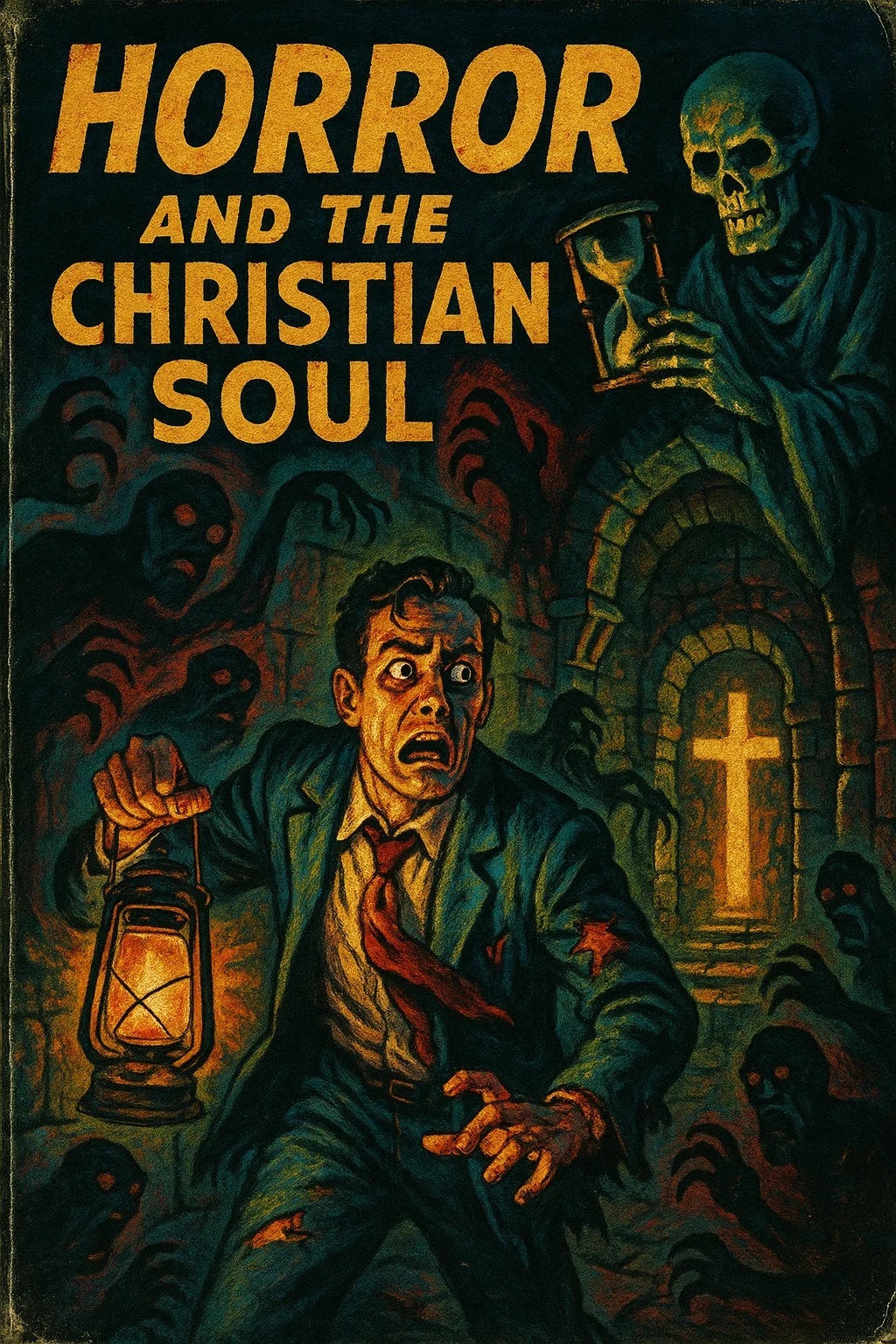
Every slasher movie, every gothic ghost story, every creeping monster under the bed reminds us of that first trespass and its inheritance. Even when filmmakers don’t know it, they are playing with Genesis 3.
St. Augustine put it bluntly:
“Wherefore the apostle says, ‘For we too were by nature children of wrath even as the others.’” (Enchiridion, Chapter 10).
Horror is honest about this. Unlike the self-help aisle or Disney’s latest musical, it doesn’t tell us we’re “basically good.” Horror says, “You are vulnerable, you are mortal, and something is after you.” That’s anthropology 101.
The Law as Mirror
Horror also reflects the crushing mirror of the Law. The Law, as Paul says,
“Now we know that whatsoever things the law saith, it speaketh to them that are under the law, that every mouth may be stopped, and all the world may be brought under the judgment of God” (Romans 3:19, ASV).
That’s why the best horror films trap their characters in impossible moral choices. They can’t win. No matter how hard they try, their own weakness betrays them.
The Apology of the Augsburg Confession says:
“For the conscience, terrified by the Law, cannot be quieted by works.” (Apology IV.45).
That’s not a bad summary of every classic monster story. The Law unmasks us. Horror does too.
The Fear of the Unknown—and the Known
Why do shadows and locked doors make our hearts pound? Because deep down, we already know what waits in the dark: judgment.
Hebrews tells us,
“And inasmuch as it is appointed unto men once to die, and after this cometh judgment” (Hebrews 9:27, ASV).
You don’t need a demon in the corner for that to be terrifying. Your conscience does the work just fine.
The Grotesque as a Signpost
The grotesque—whether vampires, zombies, or tentacled Lovecraftian horrors—matters because it shows us what happens when humanity is twisted away from its Creator.
Isaiah gives the picture:
“But we are all become as one that is unclean, and all our righteousnesses are as a polluted garment: and we all do fade as a leaf; and our iniquities, like the wind, take us away” (Isaiah 64:6, ASV).
And Chrysostom makes the same point in vivid fashion:
“For a dreadful, a dreadful thing is the love of money, it disables both eyes and ears, and makes men worse to deal with than a wild beast…” (Homilies on John, Homily 65).
The grotesque is a mirror of our condition apart from Christ. Horror is not inventing monsters—it’s sketching portraits.
The Need for a Savior
And here’s the clincher: horror works because it cries out for resolution. Not just a happy ending, but salvation. A world where the monster is not just slain, but death itself is destroyed.
Paul preaches,
“The last enemy that shall be abolished is death” (1 Corinthians 15:26, ASV).
Ambrose of Milan wrote:
“Death was not part of nature; it became part of nature. God did not decree death from the beginning; he prescribed it as a remedy. Human life was condemned because of sin to unremitting labour and unbearable sorrow…” (Ambrose of Milan, On the Death of Satyrus).
Horror without Christ is despair. Horror with Christ points to the cross and empty tomb. That’s why Christian anthropology fits horror like a glove: it tells us why the scream is real, and why the final word belongs to Jesus.
A Bit of Wit Before We Go
Let’s be honest. Horror movies are often filled with bad decisions: “Don’t go into the basement!” “Don’t split up!” “Don’t read Latin out loud!” But then again—Adam and Eve weren’t exactly stellar decision-makers either.
If anything, horror proves Genesis 3 is still on loop. We keep peeking behind the curtain, eating the fruit, and waking the monster. And yet, in Christ, the serpent’s head is crushed. That’s not just anthropology—that’s eschatology.
Conclusion
So why does horror resonate so deeply with us? Because it knows us. It understands that we are frail flesh, haunted by guilt, and pursued by death. But it also leaves us aching for deliverance.
As Paul says,
“Wretched man that I am! who shall deliver me out of the body of this death? I thank God through Jesus Christ our Lord” (Romans 7:24–25, ASV).
That’s why horror resonates with Christian anthropology. Because horror tells the truth about us. And Christ tells the truth that sets us free.